GHRH Reconstitution Calculator
Enter the amount you want to measure. The vial buttons will highlight which vial strengths create cleaner syringe-unit measurements.
What amount do you need?
Type the target amount, then choose mg or mcg. Example: 2mg or 500mcg.
Syringe size:
Possible vial strengths:
Best Match
Good Match
Usable
Harder to Measure
Example GHRH Titration Schedule
| Per-Dose Amount | Units (U-100) | Injection Volume (mL) |
|---|---|---|
| 100 mcg (0.10 mg) | 4 units | 0.04 mL |
| 200 mcg (0.20 mg) | 8 units | 0.08 mL |
| 300 mcg (0.30 mg) | 12 units | 0.12 mL |
| 400 mcg (0.40 mg) | 16 units | 0.16 mL |
| 500 mcg (0.50 mg) | 20 units | 0.20 mL |
Possible vial strengths:
What Is It?
GHRH
Native GH-releasing hormone reference compound.
Bacteriostatic Water
Sterile water containing a bacteriostatic preservative, commonly used when preparing multi-use research vials.
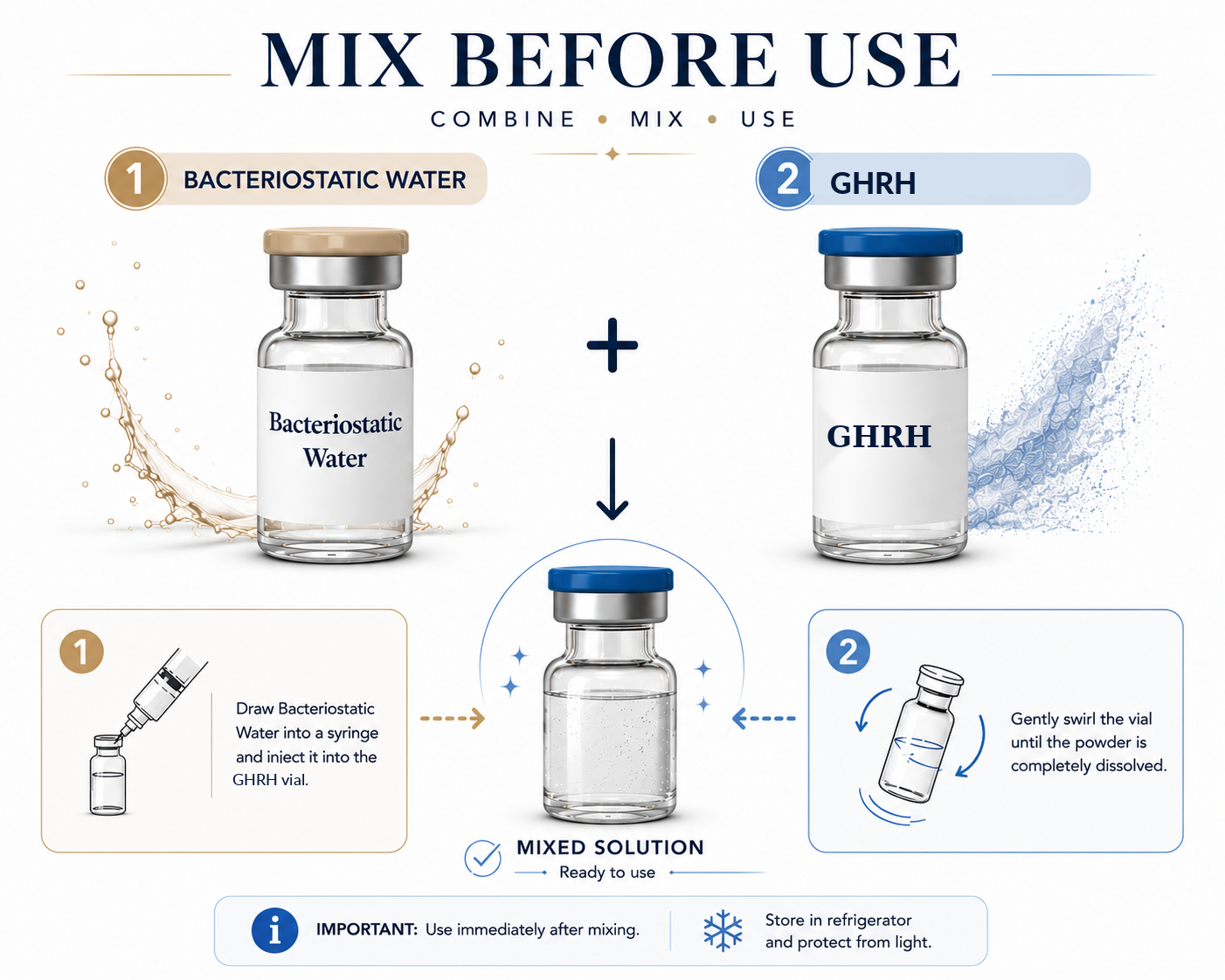
How To Mix GHRH
1
CleanUse alcohol swabs to clean the tops of both vials.
2
Draw BAC WaterDraw the selected amount of bacteriostatic water.
3
Inject SlowlyAdd the liquid slowly down the side of the vial.
4
Swirl GentlyDo not shake. Swirl gently until dissolved.
5
Store ProperlyStore as directed and protect from heat and light.
Best Practices & Common Mistakes
Best Practices
- Use sterile technique.
- Protect from light and heat.
- Store refrigerated when appropriate.
- Use clean syringe-unit math before measuring.
Common Mistakes
- Confusing milligrams with milliliters.
- Choosing an option with awkward decimal units.
- Using too little liquid for very small measurements.
- Shaking the vial aggressively.
GHRH Storage & Handling
Lyophilized Powder: −20°C (−4°F) for long-term storage (up to 24 months). Refrigeration 2–8°C (36–46°F) for short-term use (up to ~3 months). Original sealed vial in the freezer is safest.
Reconstituted Solution: 2–8°C (36–46°F), use within ~7–14 days. Keep sealed, avoid light, and do not repeat freeze-thaw cycles.
Reconstituted Solution: 2–8°C (36–46°F), use within ~7–14 days. Keep sealed, avoid light, and do not repeat freeze-thaw cycles.
Frequently Asked Questions
GHRH’s short half-life is a key characteristic. Your calculator helps you reconstitute the powder correctly, but the bioactivity window after injection depends on your study’s protocol. For standard GHRH, manufacturers of lyophilized GHRH recommend specific storage and reconstitution guidelines: the lyophilized powder is stable at room temperature for up to 3 weeks but should be stored desiccated below -18°C for long-term use. After reconstitution, the solution should be stored at 4°C and used within 2-7 days; for future use, it should be frozen below -18°C. The calculator does not know about these time frames, so for research requiring full bioactivity, you should adhere strictly to the recommended 2-7 day post-reconstitution window.
Your calculator assumes the peptide remains fully potent from the first dose to the last. However, the degradation of GHRH in neutral aqueous solution is linked to the deamidation of its asparagine residues. This means the peptide's activity gradually declines over time, even under refrigeration. For longer-term research, you cannot rely on the calculator’s Doses per vial count. Manufacturers recommend adding a carrier protein, such as 0.1% HSA or BSA, to help stabilize the solution after reconstitution.
Your calculator does not automatically convert µg/kg/day doses into mg. You must first calculate your total daily dose by multiplying your body weight in kg by the desired dose per kg. For example, a 70 kg subject following a study protocol for pulsatile GHRH 1-40 at 4 µg/kg/day would require a total of 280 µg/day (0.28 mg/day). This is the number you would enter into your calculator. However, for pulsatile administration, you would reconstitute the vial and then split that daily total into multiple, smaller, equally-sized injections across the day. The calculator’s Doses per vial display is useful here: it shows the theoretical maximum number of doses, but you must divide your daily total by your desired injection frequency per day to find the volume for each pulse injection.
Your calculator’s concentration math is solvent-agnostic; it works regardless of whether you use BAC water or 1% acetic acid. However, using acetic acid would circumvent the benzyl alcohol preservative in BAC water, which is critical for preventing bacterial growth in multi-dose vials. Manufacturers advise that after reconstitution, GHRH should be stored at 4°C and used within 2-7 days. This timeframe might be even shorter with acetic acid due to the lack of a preservative. If your research protocol requires a clear, highly concentrated solution (>1 mg/mL) and you plan to use it immediately, 1% acetic acid is an option. However, if you need multiple doses from a single vial over several days, BAC water is the superior choice for sterility.
CJC‑1295 without DAC is a synthetic peptide derivative of GHRH. Unlike the standard GHRH peptide, this analogue does not contain a Drug Affinity Complex (DAC) moiety, which means it has a shorter half-life than the DAC-conjugated version. Its primary purpose in research is to be administered via small, frequent injections. Your calculator is ideally suited for this precise task. Once you reconstitute a CJC‑1295 vial, you can use the calculator to determine the exact units for a single, small dose. The Doses per vial display then tells you how many of these small, frequent doses the vial contains, enabling you to plan a multi-day schedule of injections without remixing.
Practical takeaway: If your real goal is weight or metabolic health, the most useful next step is discussing approved treatment options with a clinician rather than relying on an unapproved compound.
Important: This tool is for informational and research-reference purposes only. Not intended for human or veterinary use.