Hexarelin Reconstitution Calculator
Enter the amount you want to measure. The vial buttons will highlight which vial strengths create cleaner syringe-unit measurements.
What amount do you need?
Type the target amount, then choose mg or mcg. Example: 2mg or 500mcg.
Syringe size:
Possible vial strengths:
Best Match
Good Match
Usable
Harder to Measure
Example Hexarelin Titration Schedule
| Protocol Item | Guidance |
|---|---|
| Dose | 100–500 mcg per dose |
| Cycling | 1–7× weekly, 4–6 weeks on, 4–6 weeks off |
Possible vial strengths:
What Is It?
Hexarelin
Potent GH secretagogue investigated for cardiac models.
Bacteriostatic Water
Sterile water containing a bacteriostatic preservative, commonly used when preparing multi-use research vials.
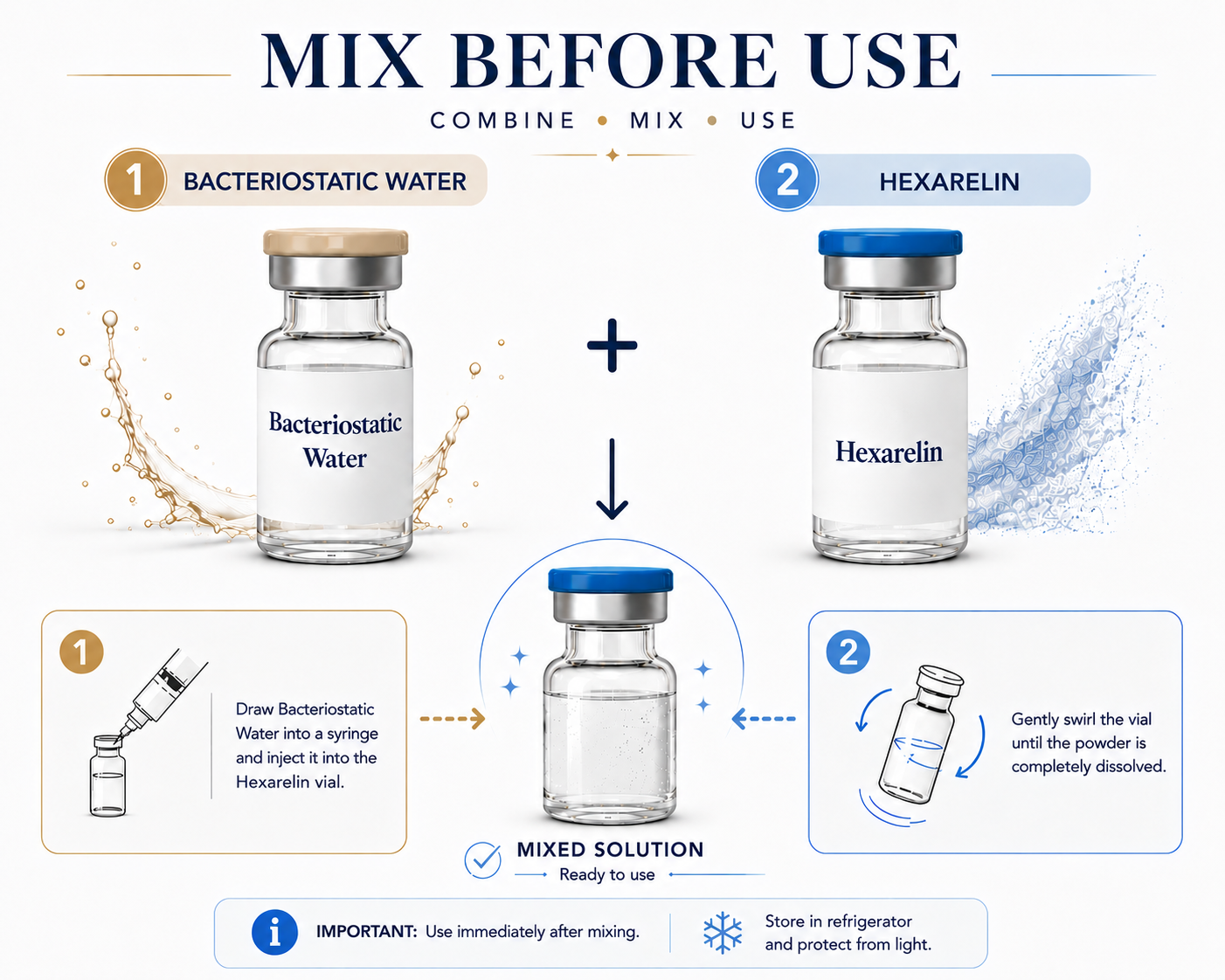
How To Mix Hexarelin
1
CleanUse alcohol swabs to clean the tops of both vials.
2
Draw BAC WaterDraw the selected amount of bacteriostatic water.
3
Inject SlowlyAdd the liquid slowly down the side of the vial.
4
Swirl GentlyDo not shake. Swirl gently until dissolved.
5
Store ProperlyStore as directed and protect from heat and light.
Best Practices & Common Mistakes
Best Practices
- Use sterile technique.
- Protect from light and heat.
- Store refrigerated when appropriate.
- Use clean syringe-unit math before measuring.
Common Mistakes
- Confusing milligrams with milliliters.
- Choosing an option with awkward decimal units.
- Using too little liquid for very small measurements.
- Shaking the vial aggressively.
Hexarelin Storage & Handling
Lyophilized Powder: −20°C (−4°F) for long-term storage (up to 24 months). Refrigeration 2–8°C (36–46°F) for short-term use (up to ~3 months). Original sealed vial in the freezer is safest.
Reconstituted Solution: 2–8°C (36–46°F), use within ~7–14 days. Keep sealed, avoid light, and do not repeat freeze-thaw cycles.
Reconstituted Solution: 2–8°C (36–46°F), use within ~7–14 days. Keep sealed, avoid light, and do not repeat freeze-thaw cycles.
Frequently Asked Questions
Hexarelin is a synthetic hexapeptide that is structurally similar to GHRP‑6 but contains a key modification: the D‑tryptophan residue is replaced with its 2‑methyl derivative. This change makes Hexarelin more resistant to proteolytic degradation than GHRP‑6, a property that has made it a valuable tool in research. Your calculator’s “doses per vial” display provides a mathematical maximum, but in practice, this increased stability means your reconstituted Hexarelin solution is likely to remain closer to full potency for the duration of a multi‑day protocol compared to many other GHRPs, which degrade more rapidly after mixing.
The biology of desensitisation is critical and your calculator does not account for it. In isolated cells, the growth‑hormone secretagogue receptor can desensitise within minutes of first exposure to Hexarelin; a marked desensitisation of the calcium response was observed only 2–5 minutes after the first dose. However, in living subjects, chronic intermittent treatment with Hexarelin does not desensitise the GH response, whereas a continuous infusion would. Therefore, when you use your calculator to plan a multi‑week study, you must ensure that the interval between injections (e.g., at least a few hours) is sufficient to allow receptor recovery. If you inadvertently use the calculator to prepare a protocol with multiple closely spaced daily injections, the peptide may lose efficacy despite the solution remaining chemically stable.
Hexarelin has a recommended reconstitution pH range of 4.0–7.0. Standard bacteriostatic water typically has a pH around 5.5, which falls within this range. However, some supplier data explicitly recommend that for best results, Hexarelin should be reconstituted with 50% bacteriostatic water and 50% acetic acid. This 50/50 mixture further lowers the pH, improving the solubility and stability of the peptide over time. Your calculator will faithfully compute concentration and units for any volume of liquid you choose, but it cannot warn you that using pure BAC water for storage beyond 7 days may lead to faster degradation. For this peptide, if you plan to use the calculator for a multi‑week protocol, consider using the acidic 50/50 mixture as your solvent.
Your calculator assumes you will draw one or two doses per day, but Hexarelin’s pharmacokinetics are unique. In humans, intravenous Hexarelin has a half‑life of approximately 55 minutes, with plasma GH levels peaking at about 30 minutes and returning to baseline within 4 hours. In rats, a similar half‑life of about 75 minutes has been observed. This short half‑life means that to maintain elevated GH levels, researchers often administer Hexarelin multiple times per day. The number of doses you plan per day directly affects how many days a single vial will last, which in turn affects whether the calculator’s “doses per vial” number is a realistic guide.
Your calculator tells you how many mg to draw; it does not compute plasma concentrations. However, you can use the calculator to determine the mass of Hexarelin needed for a dose, then convert that to a predicted peak plasma concentration using the known volume of distribution. For example, in rats, the volume of distribution at steady state is 744 ml/kg. If you use your calculator to prepare a dose of 100 µg/kg for a 2‑kg rat, the calculator tells you the volume to draw. You can then use the known volume of distribution to estimate the peak plasma level and assess whether your intended dose is likely to reach a therapeutic threshold. This is a crucial step for fine‑tuning a research protocol that your calculator does not perform automatically.
Practical takeaway: If your real goal is weight or metabolic health, the most useful next step is discussing approved treatment options with a clinician rather than relying on an unapproved compound.
Important: This tool is for informational and research-reference purposes only. Not intended for human or veterinary use.