MariTide (AMG-133) Reconstitution Calculator
Enter the amount you want to measure. The vial buttons will highlight which vial strengths create cleaner syringe-unit measurements.
What amount do you need?
Type the target amount, then choose mg or mcg. Example: 2mg or 500mcg.
Syringe size:
Possible vial strengths:
Best Match
Good Match
Usable
Harder to Measure
Example MariTide (AMG-133) Titration Schedule
| Parameter | Details |
|---|---|
| Typical Dosage (Phase 2) | Monthly dosing: 140 mg, 280 mg, 420 mg; Every 8 weeks: 420 mg |
| Starting & Escalation (Phase 3) | 21 mg → 35 mg → up to 350 mg (8-week titration) |
| Route of Administration | Subcutaneous (SC) injection |
| Frequency | Monthly (every 4 weeks) or less frequent (e.g., every 8–12 weeks) |
| Cycle Length | Clinical trials up to 104 weeks (~2 years) of treatment |
| Half‑Life | Extended half-life (~13–17 days); supports extended dosing intervals |
| Reconstitution | Supplied as solution; typically no reconstitution required |
Possible vial strengths:
What Is It?
MariTide (AMG-133)
GLP-1 agonist / GIPR antagonist conjugate.
Bacteriostatic Water
Sterile water containing a bacteriostatic preservative, commonly used when preparing multi-use research vials.
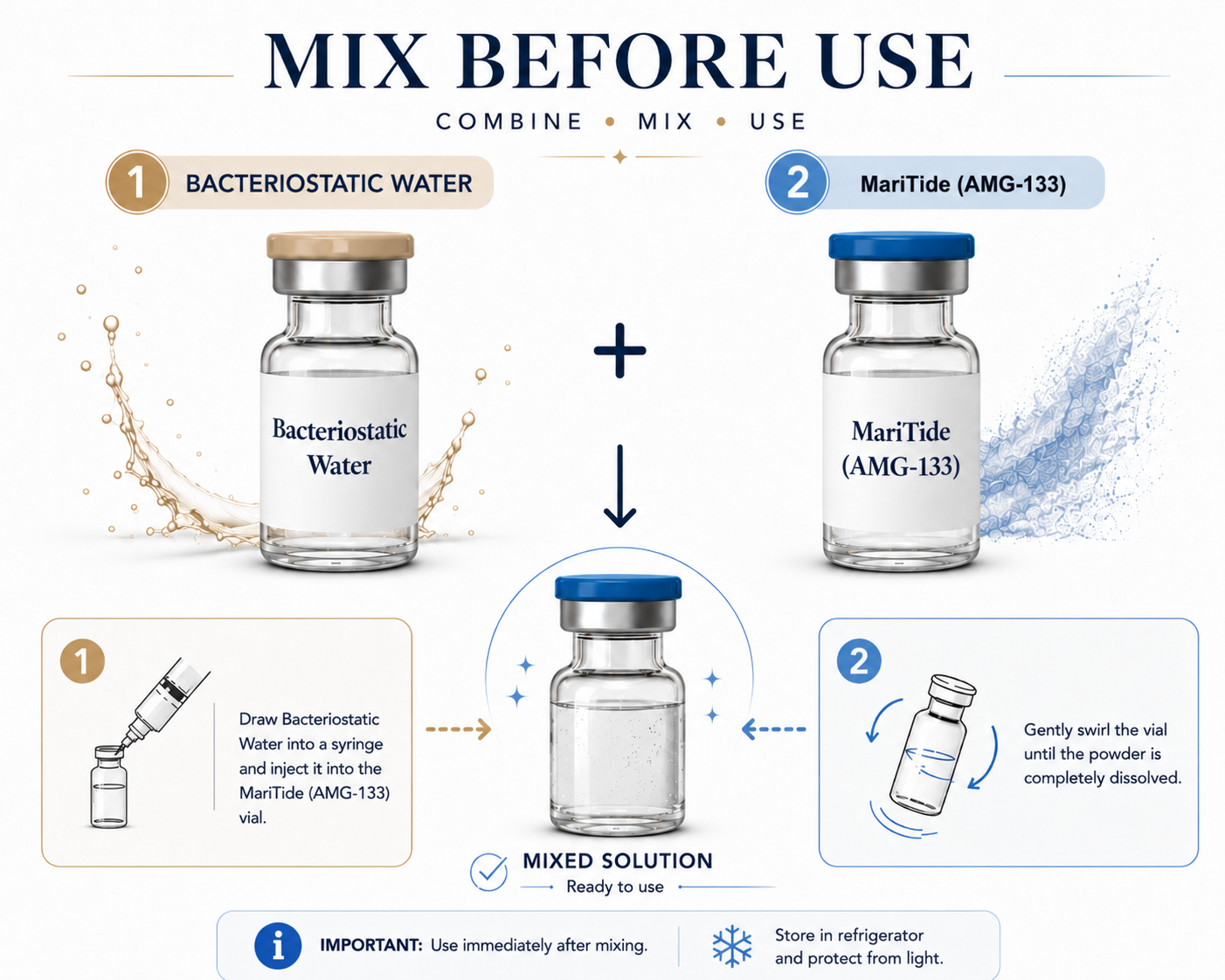
How To Mix MariTide (AMG-133)
1
CleanUse alcohol swabs to clean the tops of both vials.
2
Draw BAC WaterDraw the selected amount of bacteriostatic water.
3
Inject SlowlyAdd the liquid slowly down the side of the vial.
4
Swirl GentlyDo not shake. Swirl gently until dissolved.
5
Store ProperlyStore as directed and protect from heat and light.
Best Practices & Common Mistakes
Best Practices
- Use sterile technique.
- Protect from light and heat.
- Store refrigerated when appropriate.
- Use clean syringe-unit math before measuring.
Common Mistakes
- Confusing milligrams with milliliters.
- Choosing an option with awkward decimal units.
- Using too little liquid for very small measurements.
- Shaking the vial aggressively.
MariTide (AMG-133) Storage & Handling
Lyophilized Powder: −20°C (−4°F) for long-term storage (up to 24 months). Refrigeration 2–8°C (36–46°F) for short-term use (up to ~3 months). Original sealed vial in the freezer is safest.
Reconstituted Solution: 2–8°C (36–46°F), use within ~7–14 days. Keep sealed, avoid light, and do not repeat freeze-thaw cycles.
Reconstituted Solution: 2–8°C (36–46°F), use within ~7–14 days. Keep sealed, avoid light, and do not repeat freeze-thaw cycles.
Frequently Asked Questions
You would dangerously overdose. MariTide is an antibody‑peptide conjugate (not a simple peptide) with a terminal half‑life of 14–16 days for the intact molecule and 21–24 days for the whole conjugate. This extended half-life enables monthly or less frequent subcutaneous dosing. Injecting this mass every week would rapidly accumulate to toxic levels.
Probably not. The molecular weight is ~153,514 g/mol (average), and the compound has low water solubility (<1 mg/mL). The recommended solvent is DMSO (≥50 mg/mL) as an initial stock, followed by dilution into a multi‑component vehicle (e.g., DMSO : PEG300 : Tween 80 : saline = 10 : 40 : 5 : 45).
Much higher. In the Phase 1 multiple-dose study, participants received 140 mg, 280 mg, or 420 mg every 30 days for three months. In the Phase 2 obesity cohort, doses went up to 420 mg per month. Even the lowest active dose studied was 140 mg per month.
No. As a large antibody‑peptide conjugate, once reconstituted in an appropriate vehicle (e.g., from DMSO stock), the working solution should be stored at 4°C for only 1‑2 weeks for short‑term use. The pure powder itself is stable at -20°C for 3 years or 4°C for 2 years.
No. The Phase 2 trial showed distinct efficacy, safety, and tolerability ceilings. While weight loss at 52 weeks scaled with dose in the 140 mg to 420 mg monthly range (up to ~20% average loss), dose escalation arms had significantly lower GI adverse event dropout rates than fixed high‑dose arms. The 140 mg dose alone produced weight loss while being better tolerated.
Practical takeaway: If your real goal is weight or metabolic health, the most useful next step is discussing approved treatment options with a clinician rather than relying on an unapproved compound.
Important: This tool is for informational and research-reference purposes only. Not intended for human or veterinary use.