Tesa Ipa Blend Reconstitution Calculator
Enter the amount you want to measure. The vial buttons will highlight which vial strengths create cleaner syringe-unit measurements.
What amount do you need?
Type the target amount, then choose mg or mcg. Example: 2mg or 500mcg.
Syringe size:
Possible vial strengths:
Best Match
Good Match
Usable
Harder to Measure
Example Tesa Ipa Blend Titration Schedule
| Compound | Per-Dose Range | Notes (As Listed) |
|---|---|---|
| Tesamorelin (GHRH) | 500–2000 mcg per dose | Described as a strong growth hormone–releasing hormone (GHRH). |
| Ipamorelin (GHRP) | 100–500 mcg per dose | Described as a mild growth hormone–releasing peptide (GHRP), noted for not affecting appetite, cortisol, or prolactin levels. |
Possible vial strengths:
What Is It?
Tesa Ipa Blend
Tesamorelin + ipamorelin research blend.
Bacteriostatic Water
Sterile water containing a bacteriostatic preservative, commonly used when preparing multi-use research vials.
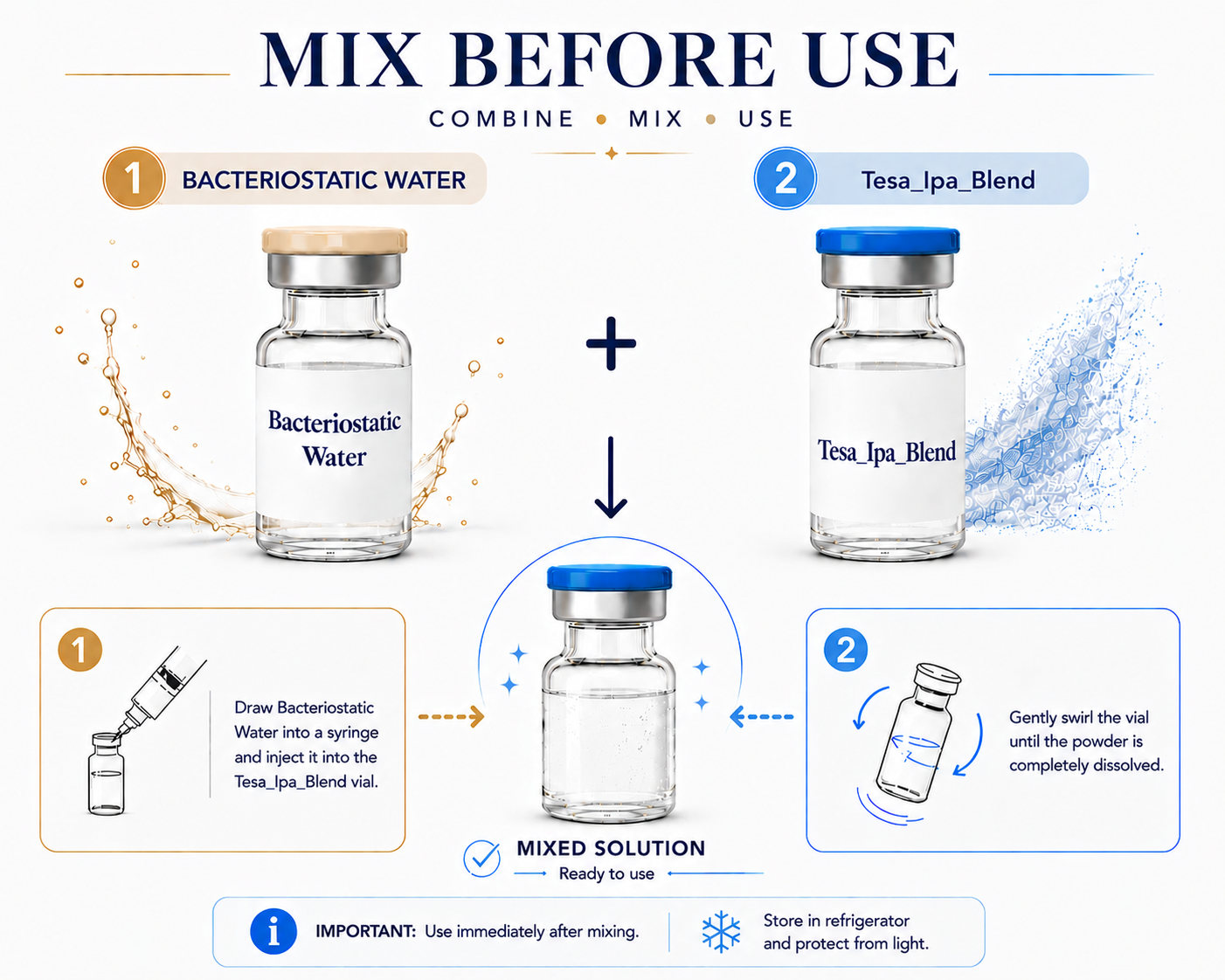
How To Mix Tesa Ipa Blend
1
CleanUse alcohol swabs to clean the tops of both vials.
2
Draw BAC WaterDraw the selected amount of bacteriostatic water.
3
Inject SlowlyAdd the liquid slowly down the side of the vial.
4
Swirl GentlyDo not shake. Swirl gently until dissolved.
5
Store ProperlyStore as directed and protect from heat and light.
Best Practices & Common Mistakes
Best Practices
- Use sterile technique.
- Protect from light and heat.
- Store refrigerated when appropriate.
- Use clean syringe-unit math before measuring.
Common Mistakes
- Confusing milligrams with milliliters.
- Choosing an option with awkward decimal units.
- Using too little liquid for very small measurements.
- Shaking the vial aggressively.
Tesa Ipa Blend Storage & Handling
Lyophilized Powder: −20°C (−4°F) for long-term storage (up to 24 months). Refrigeration 2–8°C (36–46°F) for short-term use (up to ~3 months). Original sealed vial in the freezer is safest.
Reconstituted Solution: 2–8°C (36–46°F), use within ~7–14 days. Keep sealed, avoid light, and do not repeat freeze-thaw cycles.
Reconstituted Solution: 2–8°C (36–46°F), use within ~7–14 days. Keep sealed, avoid light, and do not repeat freeze-thaw cycles.
Frequently Asked Questions
Your calculator is designed for single‑peptide vials and treats the entire powder content as one unified compound, which is perfectly acceptable for a pre‑mixed blend. However, the calculator cannot differentiate between the two peptides in its outputs, so it will not show you the separate concentration of each component in your syringe draw. For example, if you reconstitute a 10 mg blend (5 mg Tesamorelin + 5 mg Ipamorelin) with 2 mL of BAC water, your calculator will correctly display a total concentration of 5 mg/mL. This means a 10‑unit (0.1 mL) injection contains 0.5 mg of total peptide—which is actually 0.25 mg of Tesamorelin and 0.25 mg of Ipamorelin. The ratio is preserved, but the calculator won't break it down for you.
The advanced F8 (EGRIFTA WR) formulation of Tesamorelin is stable at room temperature for up to seven days after reconstitution [11†L20-L22][10†L11-L14]. This is achieved through a proprietary stabilising agent. Research‑grade Tesamorelin blends, however, do not contain this additive and must be treated as standard peptides. For your calculator’s calculations, you should assume refrigeration (2–8 °C) immediately after reconstitution. The “Doses per vial” count should be used with the understanding that the solution may degrade faster outside the fridge, and you should never keep it at room temperature beyond a few hours.
Your calculator deals only with mass (mg), not with molarity. For a blend with a fixed mass ratio, the number of molecules of each peptide in a given injection is not proportional to their mass. If a 10 mg blend contains 5 mg of each peptide, the 5 mg of Tesamorelin represents about 0.973 µmol, while 5 mg of Ipamorelin represents about 7.02 µmol. Therefore, your injection contains roughly 7 times more molecules of Ipamorelin than of Tesamorelin. If your research depends on a specific molar ratio, you cannot rely on the calculator’s mass‑based outputs. You must calculate the molarity separately using the molecular weights: Tesamorelin – 5135.85 g/mol [6†L9-L10] and Ipamorelin – 711.85 g/mol [6†L10-L11]. The calculator’s mass‑based dosing will not reflect this molecular disparity.
Tesamorelin is soluble in distilled water up to about 2 mg/mL [13†L4-L6]; exceeding this concentration may result in incomplete dissolution, cloudiness, or precipitation. Ipamorelin is much more soluble and only requires a minimal concentration of 100 µg/mL [14†L5-L7]. Therefore, the limiting factor for your blend is Tesamorelin. When your calculator recommends a small BAC volume (e.g., 1 mL for a 10 mg vial of a 5 mg + 5 mg blend), the Tesamorelin concentration would be 5 mg/mL, which far exceeds its solubility limit and will cause precipitation. To avoid this, you must increase the BAC volume to at least 2.5 mL, which brings the Tesamorelin concentration down to 2 mg/mL. Your calculator may call this a “Good” or “Usable” option rather than “Best”, but it is necessary for complete dissolution.
Your calculator assumes a single pharmacokinetic profile for whatever is in the vial. However, the two peptides differ markedly: Tesamorelin has a half‑life of approximately 2–3 hours [12†L20-L22], while Ipamorelin has a half‑life of about 2 hours in humans, but its biological activity is even shorter. The result is that a single daily injection of the blend may produce GH pulses that are sustained by Tesamorelin but which may not be fully supported by the shorter‑acting Ipamorelin. If your calculator suggests a single daily dose, you may be receiving a Tesamorelin‑dominant effect. For protocols requiring balanced GH stimulation, some research designs administer the blend twice daily to better match Ipamorelin’s shorter activity window. The calculator does not, and cannot, guide you on this pharmacological nuance.
Practical takeaway: If your real goal is weight or metabolic health, the most useful next step is discussing approved treatment options with a clinician rather than relying on an unapproved compound.
Important: This tool is for informational and research-reference purposes only. Not intended for human or veterinary use.