Orforglipron Reconstitution Calculator
Enter the amount you want to measure. The vial buttons will highlight which vial strengths create cleaner syringe-unit measurements.
What amount do you need?
Type the target amount, then choose mg or mcg. Example: 2mg or 500mcg.
Syringe size:
Possible vial strengths:
Best Match
Good Match
Usable
Harder to Measure
Example Orforglipron Titration Schedule
💊 FDA‑Approved Dosing Protocol (Foundayo®)
Orforglipron is taken as a once‑daily oral tablet with or without food. The dosing protocol follows a monthly titration schedule across six color‑coded dose strengths, with a maximum dose of 17.2 mg once daily.
Step Dose Strength Duration
1 (Starting dose) 0.8 mg once daily At least 4 weeks
2 (Titration) 2.5 mg once daily At least 4 weeks
3 (Titration) 5.5 mg once daily At least 4 weeks
4 (Titration) 9 mg once daily As tolerated
5 (Titration) 14.5 mg once daily As tolerated
6 (Maximum dose) 17.2 mg once daily Maintenance
Orforglipron is taken as a once‑daily oral tablet with or without food. The dosing protocol follows a monthly titration schedule across six color‑coded dose strengths, with a maximum dose of 17.2 mg once daily.
Step Dose Strength Duration
1 (Starting dose) 0.8 mg once daily At least 4 weeks
2 (Titration) 2.5 mg once daily At least 4 weeks
3 (Titration) 5.5 mg once daily At least 4 weeks
4 (Titration) 9 mg once daily As tolerated
5 (Titration) 14.5 mg once daily As tolerated
6 (Maximum dose) 17.2 mg once daily Maintenance
Possible vial strengths:
What Is It?
Orforglipron
Oral non-peptide GLP-1 receptor agonist.
Bacteriostatic Water
Sterile water containing a bacteriostatic preservative, commonly used when preparing multi-use research vials.
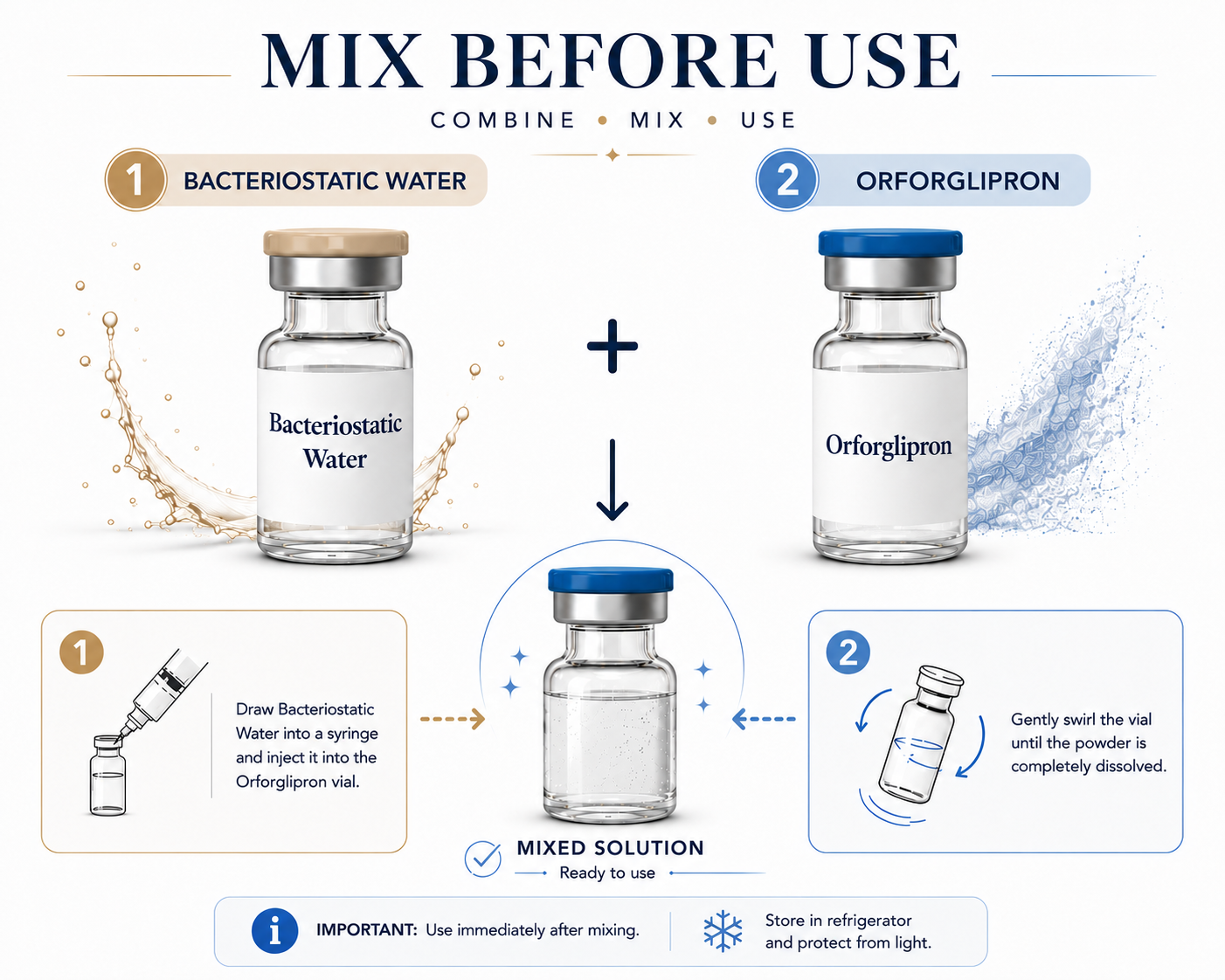
How To Mix Orforglipron
1
CleanUse alcohol swabs to clean the tops of both vials.
2
Draw BAC WaterDraw the selected amount of bacteriostatic water.
3
Inject SlowlyAdd the liquid slowly down the side of the vial.
4
Swirl GentlyDo not shake. Swirl gently until dissolved.
5
Store ProperlyStore as directed and protect from heat and light.
Best Practices & Common Mistakes
Best Practices
- Use sterile technique.
- Protect from light and heat.
- Store refrigerated when appropriate.
- Use clean syringe-unit math before measuring.
Common Mistakes
- Confusing milligrams with milliliters.
- Choosing an option with awkward decimal units.
- Using too little liquid for very small measurements.
- Shaking the vial aggressively.
Orforglipron Storage & Handling
Lyophilized Powder: −20°C (−4°F) for long-term storage (up to 24 months). Refrigeration 2–8°C (36–46°F) for short-term use (up to ~3 months). Original sealed vial in the freezer is safest.
Reconstituted Solution: 2–8°C (36–46°F), use within ~7–14 days. Keep sealed, avoid light, and do not repeat freeze-thaw cycles.
Reconstituted Solution: 2–8°C (36–46°F), use within ~7–14 days. Keep sealed, avoid light, and do not repeat freeze-thaw cycles.
Frequently Asked Questions
Orforglipron is a non‑peptide small molecule (MW 882.96) that acts on the GLP‑1 receptor without being a peptide. This means it bypasses all the typical reconstitution, bacteriostatic water, and injection calculations your tool was built for. The compound is delivered as an oral capsule.
BAC water alone cannot dissolve it. Orforglipron is insoluble in water and ethanol. The correct approach for preparing an in vivo injectable formulation is to use a multi‑component vehicle, such as 10% DMSO + 40% PEG300 + 5% Tween‑80 + 45% saline, which can yield a clear solution at ≥2 mg/mL.
As a small molecule, the dry powder is much more stable than typical peptides. The powder can be stored at -20 °C for up to 3 years, and even at 4 °C for up to 2 years. For short‑term lab use (1‑2 weeks), it can even be kept at room temperature, making it exceptionally convenient for an R&D bench environment.
Your oral dose calculations are straightforward. The compound is designed for once‑daily oral dosing without food or water restrictions. Taking it with food was not associated with a clinically relevant food effect in Phase 1 studies, and it achieves a high 79% absolute oral bioavailability without needing complex absorption enhancers.
Yes, the drug generally adheres to a linear PK model. Its long terminal half‑life (25–68 hours) supports convenient once‑daily oral dosing. However, Phase 3 trials show that weight loss is dose‑dependent: in a 36‑week obesity trial, participants taking 36 mg/day lost 14.7% of their body weight, compared to 9.4% for those on 6 mg/day, allowing you to use your calculator proportionally for higher weight‑loss goals.
Practical takeaway: If your real goal is weight or metabolic health, the most useful next step is discussing approved treatment options with a clinician rather than relying on an unapproved compound.
Important: This tool is for informational and research-reference purposes only. Not intended for human or veterinary use.