Enter the amount you want to measure. The vial buttons will highlight which vial strengths create cleaner syringe-unit measurements.
⚠ Use acetic acid — not bacteriostatic water
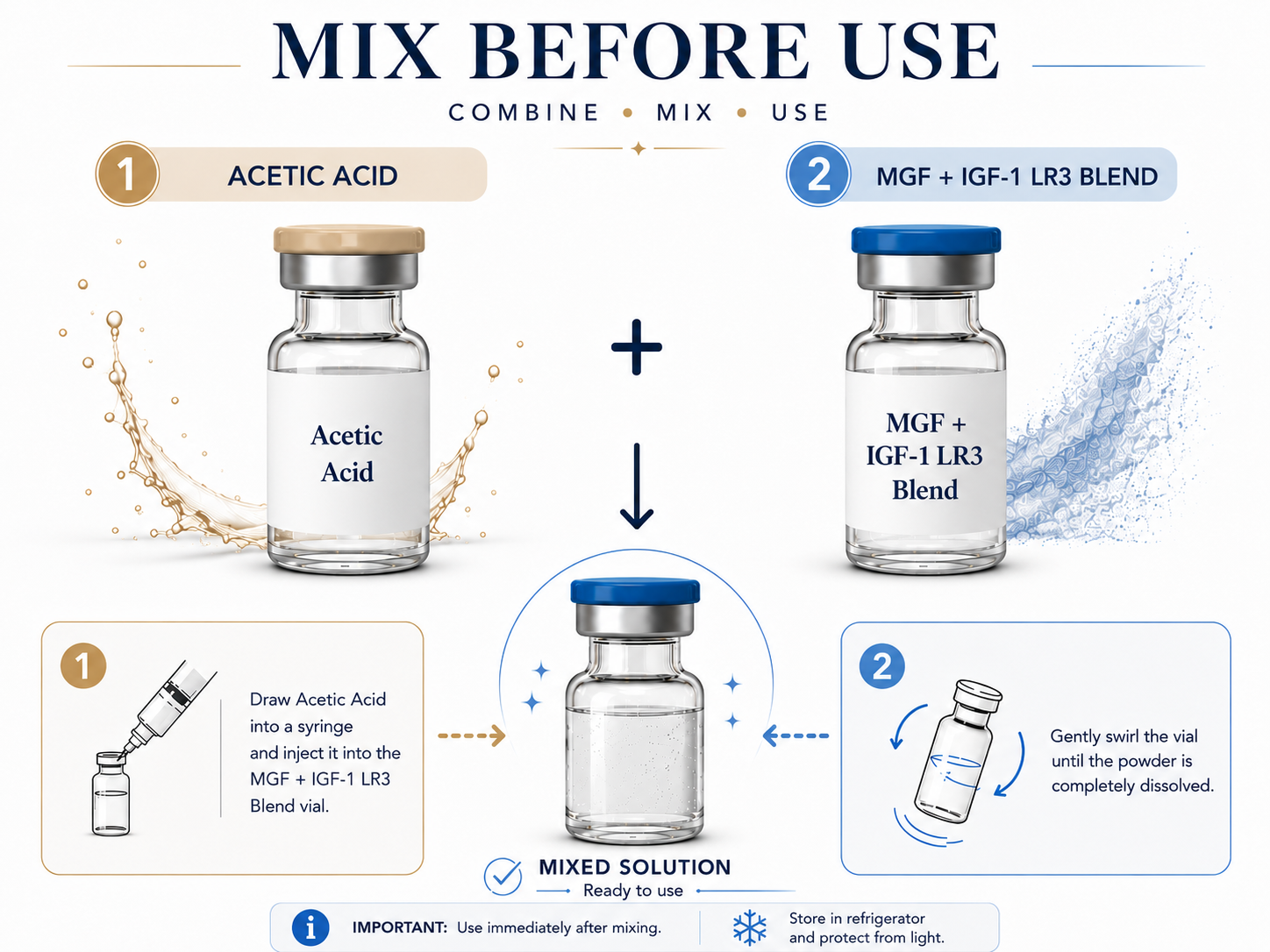
PEG-MGF + IGF-1 Blend is insoluble or unstable in standard BAC water. Manufacturer protocols require reconstitution in dilute acetic acid (0.1%) — or, for IGF-1 variants, 50 mM acetic acid. Volumes shown below refer to acetic acid, not water.
What amount do you need?
Type the target amount, then choose mg or mcg. Example: 2mg or 500mcg.
Syringe size:
Possible vial strengths:
Best Match Good Match Usable Harder to Measure
Example PEG-MGF + IGF-1 Blend Titration Schedule
Parameter
Details
Dosage (PEG-MGF)
200–400 mcg per injection, 2–3 times per week (e.g., 250–300 mcg every 3rd day)
Dosage (IGF-1 LR3)
40–60 mcg per injection (e.g., 50 mcg), 3–4 times per week on alternate days
Route
Subcutaneous (SC) or intramuscular (IM) into trained muscle groups
Dosing Strategy
Alternate days: PEG-MGF on day 1, IGF-1 LR3 on day 2. Or: PEG-MGF on off/recovery days, IGF-1 LR3 on training days post‑workout
Cycle Length
4–6 weeks on, followed by 4–8 weeks off
Half‑life (PEG-MGF)
~48–72 hours (pegylated, long‑acting)
Half‑life (IGF-1 LR3)
~20–30 hours (long‑acting analog)
Reconstitution (PEG-MGF)
Bacteriostatic water (2–2.5 mL per vial). Gently swirl. Refrigerate after reconstitution
Reconstitution (IGF-1 LR3)
0.6% acetic acid (AA) or bacteriostatic water
Possible vial strengths:
What Is It?
PEG-MGF + IGF-1 Blend
Research blend of PEG-MGF and IGF-1.
Acetic Acid (0.1%)
A dilute solution of acetic acid (typically 0.1% for most peptides, or 50 mM for IGF-1 variants) used to reconstitute peptides that are insoluble or unstable in standard bacteriostatic water. PEG-MGF + IGF-1 Blend requires an acidic carrier to dissolve fully and remain stable — plain BAC water will not work and may damage the peptide.
How To Mix PEG-MGF + IGF-1 Blend
1
Clean
Use alcohol swabs to clean the tops of both vials.
2
Draw Acetic Acid
Draw the selected amount of 0.1% acetic acid.
3
Inject Slowly
Add the liquid slowly down the side of the vial.
4
Swirl Gently
Do not shake. Swirl gently until dissolved.
5
Store Properly
Store as directed and protect from heat and light.
Best Practices & Common Mistakes
Best Practices
Use sterile technique.
Protect from light and heat.
Store refrigerated when appropriate.
Use clean syringe-unit math before measuring.
Common Mistakes
Confusing milligrams with milliliters.
Choosing an option with awkward decimal units.
Using too little liquid for very small measurements.
Shaking the vial aggressively.
PEG-MGF + IGF-1 Blend Storage & Handling
Lyophilized Powder: −20°C (−4°F) for long-term storage (up to 24 months). Refrigeration 2–8°C (36–46°F) for short-term use (up to ~3 months). Original sealed vial in the freezer is safest.
Reconstituted Solution: 2–8°C (36–46°F), use within ~7–14 days. Keep sealed, avoid light, and do not repeat freeze-thaw cycles.
Frequently Asked Questions
For a blend, you must know the ratio from the supplier (e.g., 2 mg PEG‑MGF + 2 mg IGF‑1 LR3 = 4 mg total). After reconstitution, the total concentration is what the calculator shows, but the individual concentration is half. Calculate each peptide separately—the calculator cannot split them.
PEG‑MGF circulates for 48–72 hours, while IGF‑1 LR3 is active for about 20‑30 hours. Because the half‑lives are now aligned, the blend can be injected once daily. Many protocols use 200‑400 mcg of PEG‑MGF and 40‑100 mcg of IGF‑1 LR3 daily.
Most research vendors confirm PEG‑MGF is water‑soluble, but to prevent cloudiness, use bacteriostatic water for both peptides and allow them to reach room temperature before reconstitution. If the solution remains cloudy, add more BAC water (increase volume) even if the calculator marks it as "Good" instead of "Best."
Stability is determined by the least stable peptide. For PEG‑MGF, the reconstituted solution should be stored at 4°C for 2‑21 days. For IGF‑1 LR3, refrigeration at 2‑8°C is safe for 2‑7 days. Therefore, use the blend within 2‑7 days when refrigerated. For longer storage, aliquot and freeze at –20°C; avoid repeated freeze‑thaw cycles.
A common volume is 2 mL of BAC water for a 2 mg PEG‑MGF + 2 mg IGF‑1 LR3 vial, giving a total concentration of 2 mg/mL (each peptide at 1 mg/mL). Another protocol uses 1 mL of BAC water for every 2 mg of peptide. Adjust the volume so that your daily dose (e.g., 200 mcg PEG‑MGF + 40 mcg IGF‑1 LR3) requires a draw of 10‑50 units on a U‑100 syringe.
Practical takeaway: If your real goal is weight or metabolic health, the most useful next step is discussing approved treatment options with a clinician rather than relying on an unapproved compound.