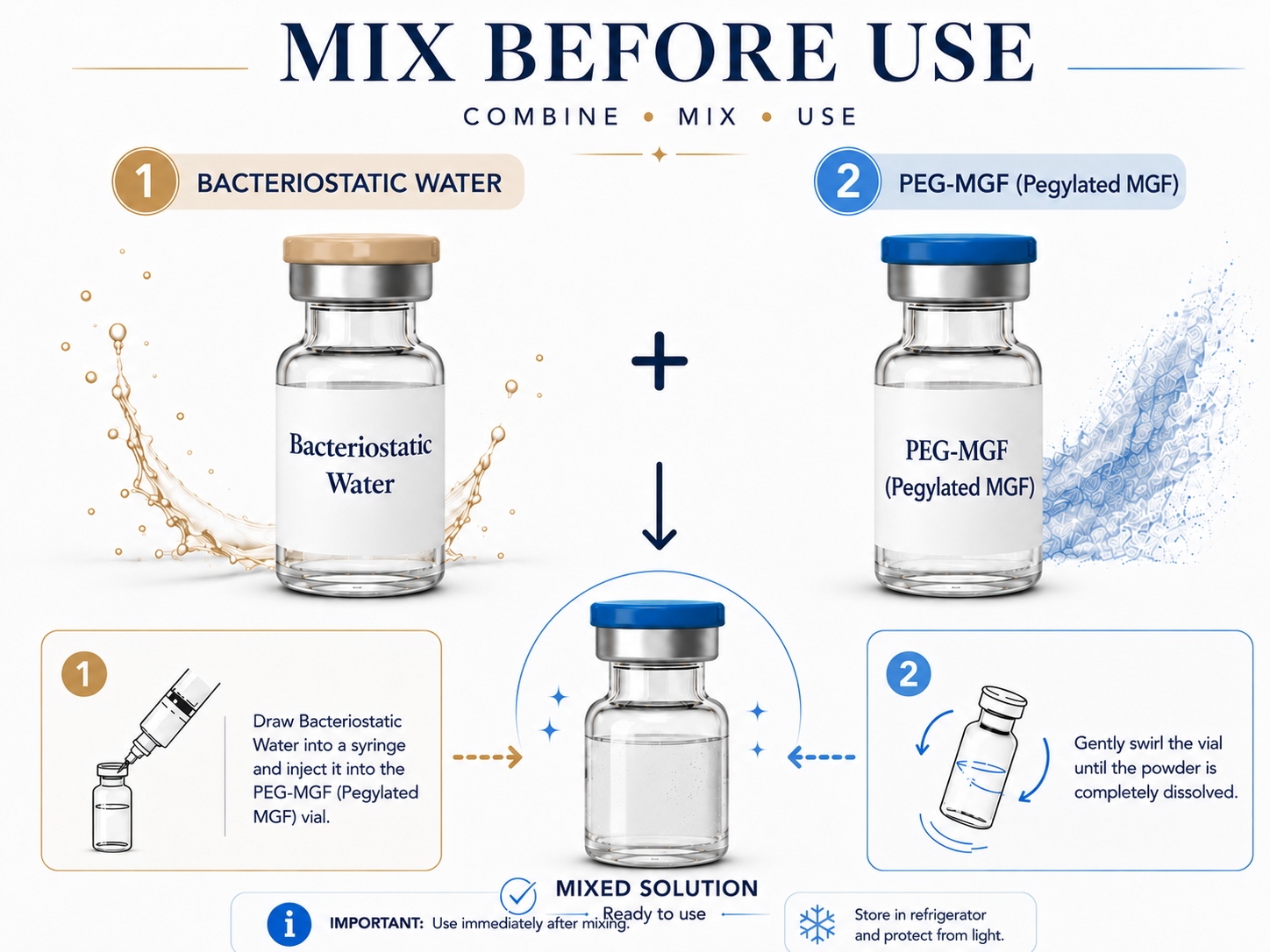
Enter the amount you want to measure. The vial buttons will highlight which vial strengths create cleaner syringe-unit measurements.
⚠ Use acetic acid — not bacteriostatic water
PEG-MGF is insoluble or unstable in standard BAC water. Manufacturer protocols require reconstitution in dilute acetic acid (0.1%) — or, for IGF-1 variants, 50 mM acetic acid. Volumes shown below refer to acetic acid, not water.
What amount do you need?
Type the target amount, then choose mg or mcg. Example: 2mg or 500mcg.
Syringe size:
Possible vial strengths:
Best Match Good Match Usable Harder to Measure
Example PEG-MGF Titration Schedule
Protocol Item
Guidance
Dose
100–500 mcg per dose
Frequency
2–3× per week
Cycle
4–8 weeks on, followed by a break equal to or longer than the usage duration (to allow a “reset” and minimize potential desensitization)
Common Timing Notes
Often used on rest days (the source notes muscle stem cell stimulation may decrease). Some theorize targeted muscle injection may increase localized effects.
Possible vial strengths:
What Is It?
PEG-MGF
Pegylated mechano growth factor variant.
Acetic Acid (0.1%)
A dilute solution of acetic acid (typically 0.1% for most peptides, or 50 mM for IGF-1 variants) used to reconstitute peptides that are insoluble or unstable in standard bacteriostatic water. PEG-MGF requires an acidic carrier to dissolve fully and remain stable — plain BAC water will not work and may damage the peptide.
How To Mix PEG-MGF
1
Clean
Use alcohol swabs to clean the tops of both vials.
2
Draw Acetic Acid
Draw the selected amount of 0.1% acetic acid.
3
Inject Slowly
Add the liquid slowly down the side of the vial.
4
Swirl Gently
Do not shake. Swirl gently until dissolved.
5
Store Properly
Store as directed and protect from heat and light.
Best Practices & Common Mistakes
Best Practices
Use sterile technique.
Protect from light and heat.
Store refrigerated when appropriate.
Use clean syringe-unit math before measuring.
Common Mistakes
Confusing milligrams with milliliters.
Choosing an option with awkward decimal units.
Using too little liquid for very small measurements.
Shaking the vial aggressively.
PEG-MGF Storage & Handling
Lyophilized Powder: −20°C (−4°F) for long-term storage (up to 24 months). Refrigeration 2–8°C (36–46°F) for short-term use (up to ~3 months). Original sealed vial in the freezer is safest.
Reconstituted Solution: 2–8°C (36–46°F), use within ~7–14 days. Keep sealed, avoid light, and do not repeat freeze-thaw cycles.
Frequently Asked Questions
While this small shift is negligible when working with standard peptide molecular weights (e.g., ±1 g/mol on a 3000 g/mol molecule introduces only a 0.03 % error), the real problem is that the supplier may not clearly state whether the reported molecular weight (e.g., 2867.2 g/mol) is for the amidated or the non‑amidated form.
Additionally, the pegylation itself introduces a major source of molecular weight uncertainty. Reported molecular weights for PEG‑MGF vary from 2848.13 g/mol to 2948.15 g/mol (a difference of 100 g/mol) depending on the length of the PEG chain and the supplier. Your calculator only works with the mass (mg) you type in; it cannot detect these inconsistencies. If you blindly use a molecular weight from an online source without verifying it against your vial’s Certificate of Analysis, your molarity calculations for cell culture or receptor binding studies will be inaccurate from the start.
If you use the calculator’s “Best” suggestion of 1 mL of BAC water for a 2 mg vial, the solution may remain cloudy or exhibit visible particulates, which would make the calculated concentration a mathematical illusion.
The established working practice for PEG‑MGF is to avoid this high concentration. Use at least 2 mL of BAC water per 2 mg vial (a concentration of 1 mg/mL), and store the solution in the fridge at 4 °C once mixed. If the powder still fails to dissolve completely, you must perform the initial dissolution in 60 % acetonitrile/water before diluting to your final volume.
Comparing native MGF (half‑life 2‑3 minutes) to PEG‑MGF (half‑life 30‑60 minutes in plasma, and up to 24–72 hours in some tissues), the same weekly dose might need to be administered dozens of times for native MGF to achieve similar total exposure. In practical terms, if you have an established research protocol for native MGF (e.g., 200 mcg administered several times per day due to rapid degradation), the same 200 mcg dose of PEG‑MGF injected twice per week could be more than enough to achieve equivalent total body exposure. The calculator will show the same mg dose and units for both peptides, but the biological exposure will differ by an order of magnitude.
Literature‑supported PEG‑MGF research protocols use an injectable (subcutaneous or intramuscular) dose of 200–400 mcg per injection, administered 2‑3 times per week. For a 2 mg vial reconstituted with 2 mL of BAC water (concentration 1 mg/mL), a 200 mcg dose requires 0.2 mL (20 units). For a 400 mcg dose, it requires 0.4 mL (40 units). Both volumes are comfortable for a U‑100 syringe.
If you followed the calculator’s “Best” 1 mL reconstitution (2 mg/mL), a 400 mcg dose would be 0.2 mL (20 units). That’s still a valid injection, but you lose the flexibility to adjust the dose finely across the 200‑400 mcg range. Additionally, more concentrated solutions can cause more injection site discomfort, a known issue for pegylated compounds. Your calculator doesn’t know about injection site tolerance; you must decide whether a slightly less “neat” concentration (e.g., using 2 mL BAC) is better for your research protocol.
Native MGF is produced locally in damaged muscle tissue and exerts its effects at the injury site before being degraded within minutes. It is not a circulating hormone. PEG‑MGF, due to pegylation, resists degradation and can survive systemic circulation.
If you administer PEG‑MGF subcutaneously (as your calculator assumes), the peptide will be absorbed relatively slowly and will create a systemic, sustained signal that affects muscle tissue throughout the body. If you administer it intramuscularly, you will achieve a higher local concentration at the injection site, which may mimic the natural spatiotemporal pattern of native MGF.
Both routes are used in research, but the calculator does not know which route you selected. The “doses per vial” count for a 2 mg vial is identical regardless of route, but the biological activity per dose could differ markedly. Always specify the route in your lab notebook separately from the calculator’s output. If you are comparing results from intramuscular versus subcutaneous administration, keep in mind that the same mass of peptide can produce different tissue distributions, a nuance your calculator cannot capture.
Practical takeaway: If your real goal is weight or metabolic health, the most useful next step is discussing approved treatment options with a clinician rather than relying on an unapproved compound.