MK-677 (Ibutamoren) Reconstitution Calculator
Enter the amount you want to measure. The vial buttons will highlight which vial strengths create cleaner syringe-unit measurements.
What amount do you need?
Type the target amount, then choose mg or mcg. Example: 2mg or 500mcg.
Syringe size:
Possible vial strengths:
Best Match
Good Match
Usable
Harder to Measure
Example MK-677 (Ibutamoren) Titration Schedule
| Week | Daily Dose (mcg) | Injection Volume (mL / Units) |
|---|---|---|
| Weeks 1–2 | 200 mcg (0.200 mg) | 0.06 mL (6 units) |
| Weeks 3–4 | 300 mcg (0.300 mg) | 0.09 mL (9 units) |
| Weeks 5–6 | 400 mcg (0.400 mg) | 0.12 mL (12 units) |
| Weeks 7–12 | 500 mcg (0.500 mg) | 0.15 mL (15 units) |
Possible vial strengths:
What Is It?
MK-677 (Ibutamoren)
Orally active ghrelin receptor agonist.
Bacteriostatic Water
Sterile water containing a bacteriostatic preservative, commonly used when preparing multi-use research vials.
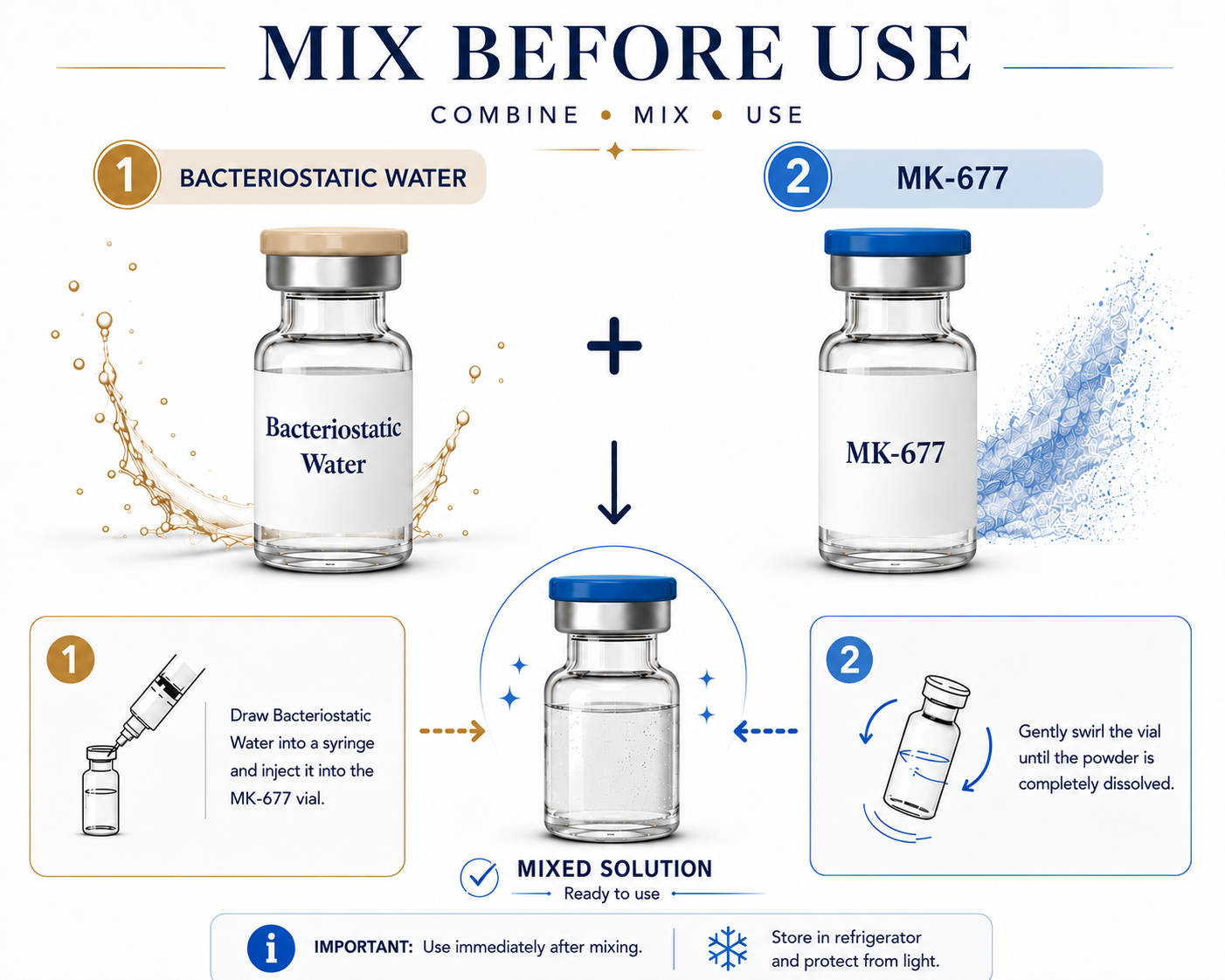
How To Mix MK-677 (Ibutamoren)
1
CleanUse alcohol swabs to clean the tops of both vials.
2
Draw BAC WaterDraw the selected amount of bacteriostatic water.
3
Inject SlowlyAdd the liquid slowly down the side of the vial.
4
Swirl GentlyDo not shake. Swirl gently until dissolved.
5
Store ProperlyStore as directed and protect from heat and light.
Best Practices & Common Mistakes
Best Practices
- Use sterile technique.
- Protect from light and heat.
- Store refrigerated when appropriate.
- Use clean syringe-unit math before measuring.
Common Mistakes
- Confusing milligrams with milliliters.
- Choosing an option with awkward decimal units.
- Using too little liquid for very small measurements.
- Shaking the vial aggressively.
MK-677 (Ibutamoren) Storage & Handling
Lyophilized Powder: −20°C (−4°F) for long-term storage (up to 24 months). Refrigeration 2–8°C (36–46°F) for short-term use (up to ~3 months). Original sealed vial in the freezer is safest.
Reconstituted Solution: 2–8°C (36–46°F), use within ~7–14 days. Keep sealed, avoid light, and do not repeat freeze-thaw cycles.
Reconstituted Solution: 2–8°C (36–46°F), use within ~7–14 days. Keep sealed, avoid light, and do not repeat freeze-thaw cycles.
Frequently Asked Questions
The calculator is a dilution tool that can be used for any dry powder. However, MK‑677 is formulated for oral administration and is not intended for injection. Its pharmacokinetics, bioavailability, and safety in an injectable form have not been established for research. Published data describe it exclusively as an oral compound for research. If you use the calculator to dissolve MK‑677 powder and then inject it, you would be administering the compound via a non‑validated route. The calculator’s output will be mathematically correct, but it cannot warn you about the potential for unexpected toxicity, altered absorption, or local tissue damage from the injection.
Some sources list the solubility of Ibutamoren mesylate in water as being over 50 mg/mL. While the calculator assumes the powder will simply dissolve, the fact that the compound is hygroscopic means it readily absorbs moisture from the air. This can lead to clumping, making it harder to dissolve accurately. If your powder has caked together before you use it, the calculator’s volume will be based on an ideal powder, not the sticky, clumped material you have. To get accurate results, ensure your powder is stored desiccated and at room temperature before use.
You must first convert the mg/kg dose into a total mg amount for the subject. For example, a study on dogs used a dose of 5 mg/kg/day. For a 10 kg animal, that is 50 mg total. You can enter this 50 mg into the calculator’s Desired dose field. But you will also need to decide on a vehicle. For an oral liquid suspension, you will need to calculate the desired concentration (e.g., 50 mg / 0.5 mL = 100 mg/mL) and then use that to determine how much powder and solvent to combine. The calculator’s “Doses per vial” display is not directly relevant here, as a single vial may contain enough powder for many animals.
The calculator assumes the solution remains fully potent for the duration of your use. For MK‑677, one source states that after reconstitution in a solvent, the solution should be stored at -20 °C and used within 1 to 3 months to prevent loss of potency. It also notes that you should aliquot the solution to avoid multiple freeze/thaw cycles. Therefore, the calculator’s “Doses per vial” count is only a guide. For a long-term study, you could prepare a single concentrated stock, freeze it, and draw doses as needed, but the calculator cannot help you calculate the number of doses after multiple freeze‑thaw cycles or tell you how quickly the solution will degrade.
The calculator only displays a concentration and volume. It does not account for non‑linear pharmacokinetics. In clinical research, the most common dose is 25 mg/day. A dose comparison study found that increasing the dose from 10 mg to 25 mg produced a 17% increase in bone turnover markers, but doses above 25 mg have been shown to have a significant diminishing return. If you use the calculator to prepare a 50 mg or 100 mg dose, you would not get proportionally more GH release. The calculator’s output is mathematically correct, but the biological effect will plateau. For accurate research, you should not simply scale up the mass; you must determine the optimum dose from the literature.
Practical takeaway: If your real goal is weight or metabolic health, the most useful next step is discussing approved treatment options with a clinician rather than relying on an unapproved compound.
Important: This tool is for informational and research-reference purposes only. Not intended for human or veterinary use.