Enter the amount you want to measure. The vial buttons will highlight which vial strengths create cleaner syringe-unit measurements.
⚠ Use acetic acid — not bacteriostatic water
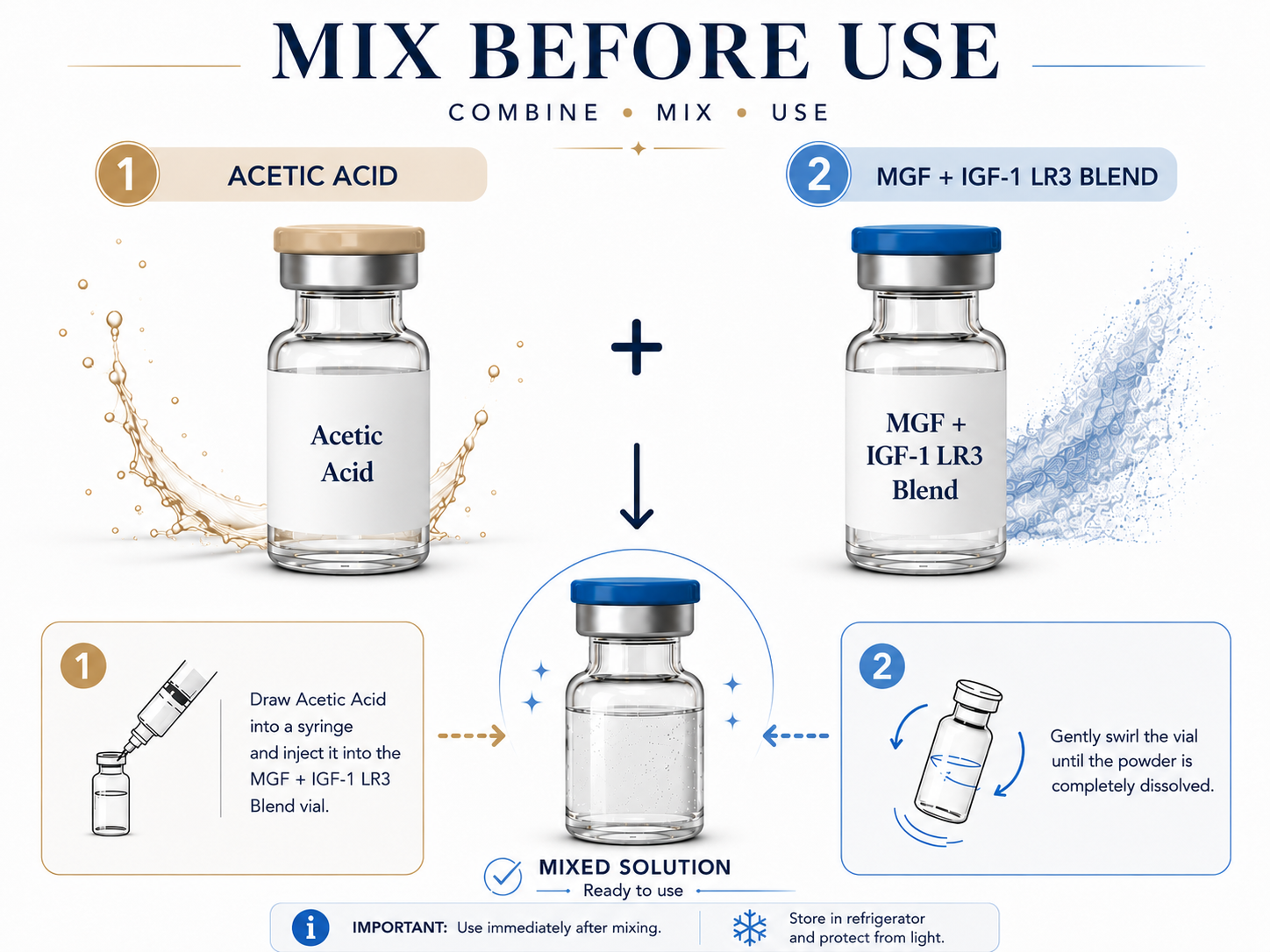
MGF + IGF-1 LR3 Blend is insoluble or unstable in standard BAC water. Manufacturer protocols require reconstitution in dilute acetic acid (0.1%) — or, for IGF-1 variants, 50 mM acetic acid. Volumes shown below refer to acetic acid, not water.
What amount do you need?
Type the target amount, then choose mg or mcg. Example: 2mg or 500mcg.
Syringe size:
Possible vial strengths:
Best Match Good Match Usable Harder to Measure
Example MGF + IGF-1 LR3 Blend Titration Schedule
Parameter
Details
Dosage (MGF)
100–200 mcg
Dosage (IGF‑1 LR3)
40–80 mcg
Route
Intramuscular (IM)
Frequency
On training days only
Timing
MGF: immediately post‑workout; IGF‑1 LR3: 30–60 min after MGF
Cycle Length
4–6 weeks on, then 4–8 weeks off
Half‑life (MGF)
Minutes
Half‑life (IGF‑1 LR3)
~20–30 hours
Reconstitution
0.6% acetic acid or bacteriostatic water
Possible vial strengths:
What Is It?
MGF + IGF-1 LR3 Blend
Research blend of MGF and IGF-1 LR3.
Acetic Acid (0.1%)
A dilute solution of acetic acid (typically 0.1% for most peptides, or 50 mM for IGF-1 variants) used to reconstitute peptides that are insoluble or unstable in standard bacteriostatic water. MGF + IGF-1 LR3 Blend requires an acidic carrier to dissolve fully and remain stable — plain BAC water will not work and may damage the peptide.
How To Mix MGF + IGF-1 LR3 Blend
1
Clean
Use alcohol swabs to clean the tops of both vials.
2
Draw Acetic Acid
Draw the selected amount of 0.1% acetic acid.
3
Inject Slowly
Add the liquid slowly down the side of the vial.
4
Swirl Gently
Do not shake. Swirl gently until dissolved.
5
Store Properly
Store as directed and protect from heat and light.
Best Practices & Common Mistakes
Best Practices
Use sterile technique.
Protect from light and heat.
Store refrigerated when appropriate.
Use clean syringe-unit math before measuring.
Common Mistakes
Confusing milligrams with milliliters.
Choosing an option with awkward decimal units.
Using too little liquid for very small measurements.
Shaking the vial aggressively.
MGF + IGF-1 LR3 Blend Storage & Handling
Lyophilized Powder: −20°C (−4°F) for long-term storage (up to 24 months). Refrigeration 2–8°C (36–46°F) for short-term use (up to ~3 months). Original sealed vial in the freezer is safest.
Reconstituted Solution: 2–8°C (36–46°F), use within ~7–14 days. Keep sealed, avoid light, and do not repeat freeze-thaw cycles.
Frequently Asked Questions
MGF (especially PEG‑MGF) may require gentle warming (37 °C) and swirling, while IGF‑1 LR3 dissolves readily. If the solution turns cloudy, increase BAC volume (e.g., from 2 mL to 3 mL) even if the calculator marks the smaller volume as “Best.” Cloudiness means incomplete dissolution and inaccurate dosing.
Yes. The optimal timing for MGF is within 30‑60 minutes after exercise to maximise satellite cell activation. IGF‑1 LR3’s long half‑life makes timing less critical. If you inject the blend post‑workout, you’re dosing IGF‑1 LR3 correctly, but if you inject at a different time (e.g., morning), you lose MGF’s window. Consider separate vials for precise timing.
Yes, but you must split the daily blend dose into two equal injections. For example, if your daily target is 400 mcg MGF + 80 mcg IGF‑1 LR3, inject half (200 mcg MGF + 40 mcg IGF‑1 LR3) twice daily. The calculator’s “Doses per vial” count will then be based on twice‑daily usage — adjust your expectations accordingly.
IGF‑1 LR3 is stable at 4 °C for 2‑7 days (some say up to 28 days). MGF (unmodified) has similar or shorter stability. To preserve both, aliquot and freeze at –20 °C immediately after reconstitution. Avoid repeated freeze‑thaw cycles. The calculator’s generic 28‑day fridge rule may degrade MGF faster than IGF‑1 LR3.
No. MGF primarily stimulates myoblast proliferation (increasing cell number), while IGF‑1 LR3 promotes differentiation (maturation of those cells). The optimal ratio for muscle growth is not 1:1, and doubling the total mass may oversaturate one pathway before the other. The calculator cannot optimise the ratio — you must use a fixed blend ratio from the supplier or prepare separate vials.
Practical takeaway: If your real goal is weight or metabolic health, the most useful next step is discussing approved treatment options with a clinician rather than relying on an unapproved compound.