Enter the amount you want to measure. The vial buttons will highlight which vial strengths create cleaner syringe-unit measurements.
⚠ Use acetic acid — not bacteriostatic water
IGF-1 LR3 is insoluble or unstable in standard BAC water. Manufacturer protocols require reconstitution in dilute acetic acid (0.1%) — or, for IGF-1 variants, 50 mM acetic acid. Volumes shown below refer to acetic acid, not water.
What amount do you need?
Type the target amount, then choose mg or mcg. Example: 2mg or 500mcg.
Syringe size:
Possible vial strengths:
Best Match Good Match Usable Harder to Measure
Example IGF-1 LR3 Titration Schedule
Usage Protocols (Based on Preclinical & Anecdotal Data)
As a research chemical, there are no clinically established protocols for human use. The following information is compiled from preclinical studies and informal community reports.
Parameter Details
Standard Research Dose Doses in research typically range from 20mcg to 100mcg per day. Some studies have used higher weight-based doses (e.g., 80-120 mcg/kg).
Common Anecdotal Dosage User reports suggest a range of 20-60 mcg injected post-workout, with some clinics recommending 100 mcg per injection. Doses for men are often cited as 40-50 mcg/day, while women may use around 20 mcg/day.
Administration Route Typically administered via subcutaneous (SubQ) or intramuscular (IM) injection into the muscle group trained that day. SubQ injection into the abdomen is also common.
Timing Due to its half-life, it is often administered once daily. Anecdotal reports suggest administering post-workout to maximize localized effects. Some clinics recommend injecting before exercise with a meal containing protein and carbohydrates to manage blood sugar.
Cycle Length A common reported cycle is 4-6 weeks on, followed by 4-8 weeks off to prevent desensitization. Some clinics suggest an 8-week on/8-week off cycle
Possible vial strengths:
What Is It?
IGF-1 LR3
Long R3 insulin-like growth factor-1 analogue.
Acetic Acid (0.1%)
A dilute solution of acetic acid (typically 0.1% for most peptides, or 50 mM for IGF-1 variants) used to reconstitute peptides that are insoluble or unstable in standard bacteriostatic water. IGF-1 LR3 requires an acidic carrier to dissolve fully and remain stable — plain BAC water will not work and may damage the peptide.
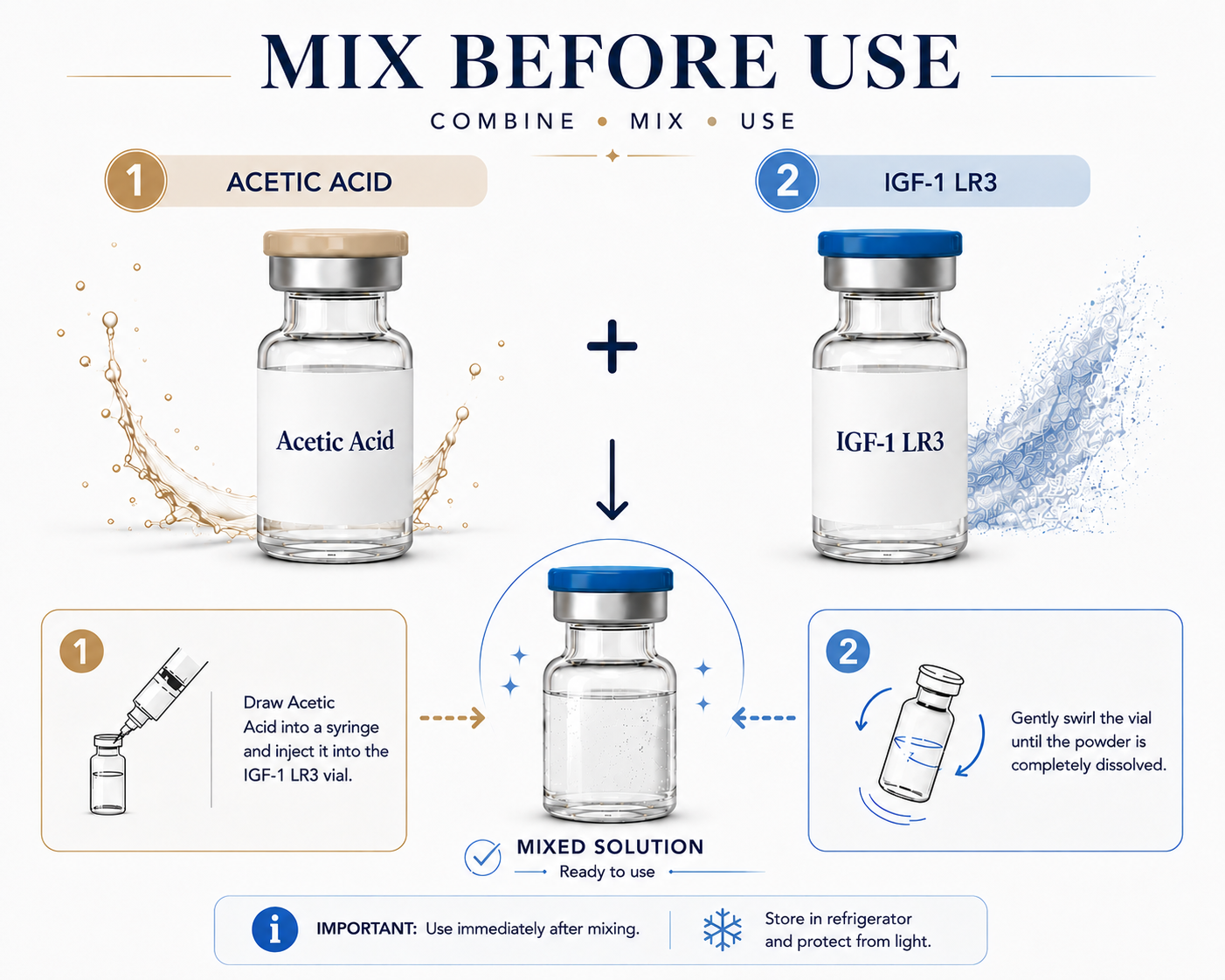
How To Mix IGF-1 LR3
1
Clean
Use alcohol swabs to clean the tops of both vials.
2
Draw Acetic Acid
Draw the selected amount of 0.1% acetic acid.
3
Inject Slowly
Add the liquid slowly down the side of the vial.
4
Swirl Gently
Do not shake. Swirl gently until dissolved.
5
Store Properly
Store as directed and protect from heat and light.
Best Practices & Common Mistakes
Best Practices
Use sterile technique.
Protect from light and heat.
Store refrigerated when appropriate.
Use clean syringe-unit math before measuring.
Common Mistakes
Confusing milligrams with milliliters.
Choosing an option with awkward decimal units.
Using too little liquid for very small measurements.
Shaking the vial aggressively.
IGF-1 LR3 Storage & Handling
Lyophilized Powder: −20°C (−4°F) for long-term storage (up to 24 months). Refrigeration 2–8°C (36–46°F) for short-term use (up to ~3 months). Original sealed vial in the freezer is safest.
Reconstituted Solution: 2–8°C (36–46°F), use within ~7–14 days. Keep sealed, avoid light, and do not repeat freeze-thaw cycles.
Frequently Asked Questions
The standard version has a half-life of just 10-12 minutes, so it requires multiple daily injections. Your LR3 is the "extended-release" version, containing a substitution (glutamic acid to arginine at position 3) and a 13-amino acid N-terminal tail that reduces its ability to bind IGFBPs. The calculated half-life is 20-30 hours, meaning your subcutaneous injection can be administered once daily, not multiple times per day.
Both are valid, but their purposes are very different. The 0.6% acetic acid (AA) creates a stable storage environment, allowing you to keep the reconstituted vial in the refrigerator for weeks or even months without significant degradation. In contrast, BAC water is a safe diluent for immediate, single-use injections, but it will degrade the peptide in just a few hours. The choice is about storage: AA for long-term storage, BAC for immediate use.
The peptide has a defined solubility limit. The datasheet recommends a minimum concentration of 100 µg/mL to ensure the lyophilized powder fully dissolves into a clear solution. If your calculator suggests a concentration that is too high (for example, trying to dissolve 1 mg in just 0.5 mL), the peptide may not dissolve completely, leading to a cloudy solution and inaccurate dosing.
Once you have dissolved the peptide, its stability is limited. It should be stored at 4°C for 2-7 days. For extended storage, the solution must be aliquoted and frozen at -20°C, where it is stable for about 3 months. Standard peptide data also states that adding a carrier protein (0.1% HSA or BSA) is recommended for long-term storage, and repeated freeze-thaw cycles are prohibited.
This is a critical safety parameter that the calculator can't see. The mechanism of action activates pathways that drive glucose into cells, which can rapidly drop blood sugar levels. If you do not consume enough carbohydrates before administration, you risk inducing hypoglycemia (low blood sugar), with symptoms like dizziness and lethargy. For this reason, a minimum intake of 50 grams of simple carbohydrates (e.g., from a sports drink or white rice) is required just prior to injection to provide adequate energy reserves
Practical takeaway: If your real goal is weight or metabolic health, the most useful next step is discussing approved treatment options with a clinician rather than relying on an unapproved compound.