Enter the amount you want to measure. The vial buttons will highlight which vial strengths create cleaner syringe-unit measurements.
⚠ Use acetic acid — not bacteriostatic water
IGF-1 DES is insoluble or unstable in standard BAC water. Manufacturer protocols require reconstitution in dilute acetic acid (0.1%) — or, for IGF-1 variants, 50 mM acetic acid. Volumes shown below refer to acetic acid, not water.
What amount do you need?
Type the target amount, then choose mg or mcg. Example: 2mg or 500mcg.
Syringe size:
Possible vial strengths:
Best Match Good Match Usable Harder to Measure
Example IGF-1 DES Titration Schedule
Parameter
Details
Typical Dosage
30–100 mcg per injection (common start: 50 mcg)
Route
Intramuscular (IM) – into targeted muscle group
Timing
10–15 minutes pre‑workout
Frequency
Once daily, on training days only
Cycle Length
4–6 weeks on, then 4–6 weeks off
Reconstitution
0.6% acetic acid (preferred) or bacteriostatic water
Storage (lyophilized)
−20°C or below
Storage (reconstituted)
4°C, use within 2–7 days; aliquot for freezing
Half‑life
~30 minutes (short, localized action)
Possible vial strengths:
What Is It?
IGF-1 DES
Truncated IGF-1 (DES 1-3) variant.
Acetic Acid (0.1%)
A dilute solution of acetic acid (typically 0.1% for most peptides, or 50 mM for IGF-1 variants) used to reconstitute peptides that are insoluble or unstable in standard bacteriostatic water. IGF-1 DES requires an acidic carrier to dissolve fully and remain stable — plain BAC water will not work and may damage the peptide.
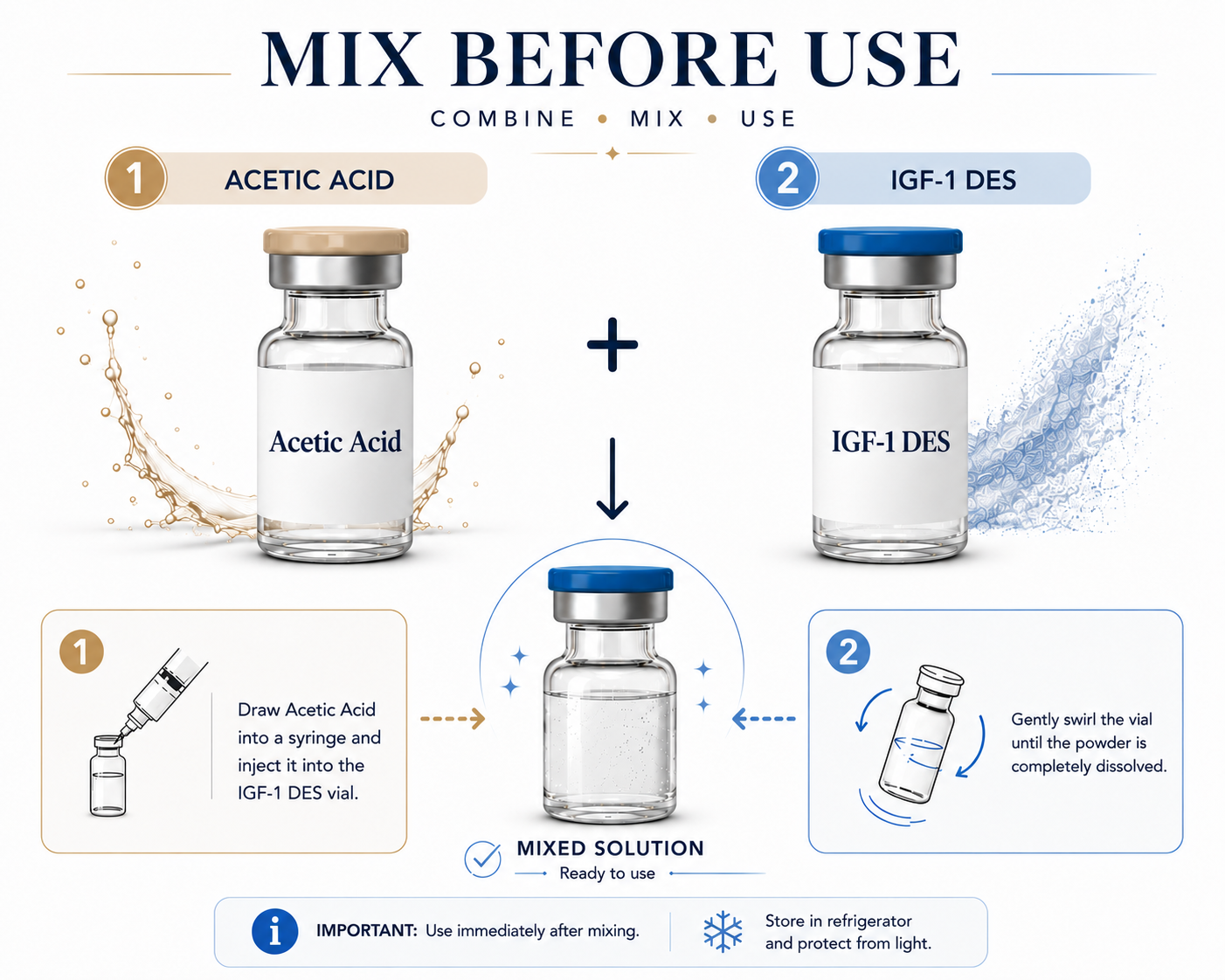
How To Mix IGF-1 DES
1
Clean
Use alcohol swabs to clean the tops of both vials.
2
Draw Acetic Acid
Draw the selected amount of 0.1% acetic acid.
3
Inject Slowly
Add the liquid slowly down the side of the vial.
4
Swirl Gently
Do not shake. Swirl gently until dissolved.
5
Store Properly
Store as directed and protect from heat and light.
Best Practices & Common Mistakes
Best Practices
Use sterile technique.
Protect from light and heat.
Store refrigerated when appropriate.
Use clean syringe-unit math before measuring.
Common Mistakes
Confusing milligrams with milliliters.
Choosing an option with awkward decimal units.
Using too little liquid for very small measurements.
Shaking the vial aggressively.
IGF-1 DES Storage & Handling
Lyophilized Powder: −20°C (−4°F) for long-term storage (up to 24 months). Refrigeration 2–8°C (36–46°F) for short-term use (up to ~3 months). Original sealed vial in the freezer is safest.
Reconstituted Solution: 2–8°C (36–46°F), use within ~7–14 days. Keep sealed, avoid light, and do not repeat freeze-thaw cycles.
Frequently Asked Questions
Because the half-life of DES is only about 20-30 minutes, you have a very short window to use it at a local injection site. For systemic exposure, it must be injected directly into the muscle (IM) you wish to affect, not just anywhere subcutaneously (SubQ). To maintain a consistent effect, some research protocols even require multiple smaller doses throughout the day. This is completely different from the calculator’s typical once-daily dose assumption.
The peptide has a defined solubility limit: It requires a minimum concentration of 0.1 mg/mL to ensure the powder fully dissolves into a clear solution. Your calculator will not know that pure BAC water may be insufficient and could cause precipitation. However, some researchers claim BAC water works, and reconstitution in BAC water has been observed to cause minimal degradation over 30 days when refrigerated, despite suppliers recommending sterile water or dilute acetic acid (0.6%) for optimal long-term stability.
You must adjust your thinking for the enhanced potency. DES has a ~10-fold higher bioavailability due to its inability to bind to serum binding proteins, which normally block IGF-1's activity. An effective research dose in animal models is typically around 50-100 mcg per day. Using regular IGF-1 equivalent would lead to a significant underdose.
The chemistry is the real constraint: Upon reconstitution, the solution should be stored at 4°C for only 2-7 days. For long-term storage, the solution must be aliquoted and frozen at -20°C. Your calculator’s 30-day assumption is dangerously optimistic and will lead to inaccurate, degraded peptide if followed.
The answer directly impacts your calculator's storage plan. For long-term storage, it is highly recommended to add a carrier protein (0.1% HSA or BSA) to enhance peptide stability. The manufacturer guidelines strongly stress to prevent freeze-thaw cycles. This means you must aliquot the reconstituted solution (with BSA) into single-use volumes immediately after mixing, then freeze. The calculator provides no warning for this essential step.
Practical takeaway: If your real goal is weight or metabolic health, the most useful next step is discussing approved treatment options with a clinician rather than relying on an unapproved compound.