GLP3 Reconstitution Calculator
Enter the amount you want to measure. The vial buttons will highlight which vial strengths create cleaner syringe-unit measurements.
What amount do you need?
Type the target amount, then choose mg or mcg. Example: 2mg or 500mcg.
Syringe size:
Possible vial strengths:
Best Match
Good Match
Usable
Harder to Measure
Example GLP3 Titration Schedule
| Phase | Weeks | Dose (mg per dose) | Frequency |
|---|---|---|---|
| Start | Weeks 1–4 | 2 mg | 1× weekly |
| Titration 1 | Weeks 5–8 | 4 mg | 1× weekly |
| Titration 2 | Weeks 9–12 | 6 mg | 1× weekly |
Possible vial strengths:
What Is It?
GLP3
Experimental GLP-3 sequence.
Bacteriostatic Water
Sterile water containing a bacteriostatic preservative, commonly used when preparing multi-use research vials.
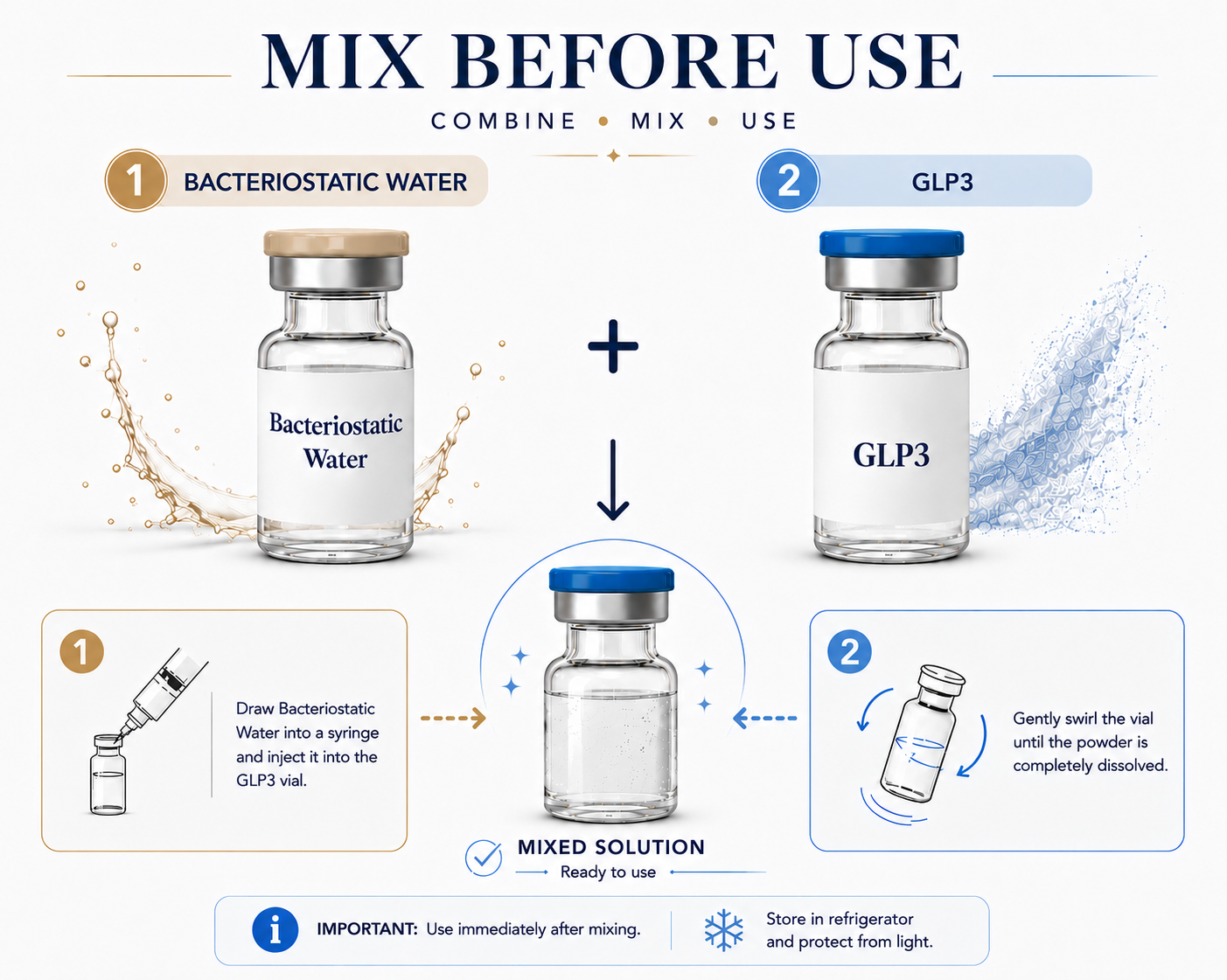
How To Mix GLP3
1
CleanUse alcohol swabs to clean the tops of both vials.
2
Draw BAC WaterDraw the selected amount of bacteriostatic water.
3
Inject SlowlyAdd the liquid slowly down the side of the vial.
4
Swirl GentlyDo not shake. Swirl gently until dissolved.
5
Store ProperlyStore as directed and protect from heat and light.
Best Practices & Common Mistakes
Best Practices
- Use sterile technique.
- Protect from light and heat.
- Store refrigerated when appropriate.
- Use clean syringe-unit math before measuring.
Common Mistakes
- Confusing milligrams with milliliters.
- Choosing an option with awkward decimal units.
- Using too little liquid for very small measurements.
- Shaking the vial aggressively.
GLP3 Storage & Handling
Lyophilized Powder: −20°C (−4°F) for long-term storage (up to 24 months). Refrigeration 2–8°C (36–46°F) for short-term use (up to ~3 months). Original sealed vial in the freezer is safest.
Reconstituted Solution: 2–8°C (36–46°F), use within ~7–14 days. Keep sealed, avoid light, and do not repeat freeze-thaw cycles.
Reconstituted Solution: 2–8°C (36–46°F), use within ~7–14 days. Keep sealed, avoid light, and do not repeat freeze-thaw cycles.
Frequently Asked Questions
Your calculator assumes the peptide in your vial corresponds to a single known hormone. However, "GLP‑3" is not an official receptor or a new human hormone — humans produce GLP‑1 and GLP‑2, but there is no "GLP‑3" hormone. "GLP‑3" is an informal internet nickname for retatrutide, an investigational drug that simultaneously activates three distinct hormone receptors: GIP, GLP‑1, and glucagon. Your calculator works perfectly for reconstituting retatrutide powder, but the name "GLP‑3" can be misleading because it suggests a single‑receptor peptide, while retatrutide is a complex multi‑agonist with unique pharmacological properties.
Your calculator is built around the assumption that you are reconstituting a vial for frequent, often daily, injections from the same vial, as the "Doses per vial" display shows. The half‑life of retatrutide is approximately 150‑180 hours, or 6 days, which means it reaches a steady state in the body after 4‑5 weeks and maintains therapeutic levels throughout a once‑weekly regimen. The clinical dosing schedule uses a single weekly injection that then sustains activity for the entire week. You should therefore use the calculator to prepare the entire weekly dose at once — not to split it into smaller daily injections — and the "Doses per vial" count will tell you how many weeks one vial lasts, not how many daily injections.
Your calculator's "Doses per vial" assumes full potency and sterility for the entire content of the vial, but retatrutide is an investigational peptide with no manufacturer‑validated stability data for reconstituted solution. General guidance suggests 28 days at 2‑8°C as a practical beyond‑use date, but this is not based on clinical studies. The 28‑day limit is primarily driven by infection risk from repeated vial puncture, not necessarily by chemical degradation. Therefore, the "Doses per vial" number is a mathematical maximum. If your weekly dose is 2 mg and the vial contains 10 mg, the calculator shows 5 doses, but you should never draw the 5th dose after more than 28 days, even if the vial is not empty.
Your calculator assumes that the peptide will completely dissolve in the chosen BAC water volume at neutral pH. However, retatrutide is reported as "slightly soluble" in water and shows only sparing solubility (1‑10 mg/mL) in PBS at pH 7.2. To achieve higher concentrations (e.g., 20‑30 mg/mL), some suppliers recommend ultrasonic treatment or adjusting the pH to 9 with aqueous NH3. If you use the calculator with a small BAC volume (e.g., 1 mL for a 10 mg vial) and the solution remains cloudy, the peptide has not fully dissolved, and the calculated units will be inaccurate. In such cases, you must use a larger BAC volume (even if the calculator marks it as "Usable" rather than "Best") or switch to an alternative solvent.
Your calculator is a point‑in‑time tool: it calculates the units for the dose you enter today. For a study lasting 68‑104 weeks with regular dose increases every 4 weeks, as used in Phase 3 trials, you will need to recalibrate your calculator at each step. For example, if you start with a 10 mg vial reconstituted with 1 mL of BAC water (10 mg/mL), the calculator will show 20 units for a 2 mg dose during weeks 1‑4, but then 40 units for a 4 mg dose during weeks 5‑8 — but your vial may already be partially used, so you must ensure enough solution remains. Your calculator does not have a "remaining volume" tracker, so for lengthy, multi‑stage protocols, consider keeping a separate log of how many units you have withdrawn from each vial.
Practical takeaway: If your real goal is weight or metabolic health, the most useful next step is discussing approved treatment options with a clinician rather than relying on an unapproved compound.
Important: This tool is for informational and research-reference purposes only. Not intended for human or veterinary use.