GLP2 Reconstitution Calculator
Enter the amount you want to measure. The vial buttons will highlight which vial strengths create cleaner syringe-unit measurements.
What amount do you need?
Type the target amount, then choose mg or mcg. Example: 2mg or 500mcg.
Syringe size:
Possible vial strengths:
Best Match
Good Match
Usable
Harder to Measure
Example GLP2 Titration Schedule
| Protocol Item | Guidance (As Listed) |
|---|---|
| Dose | 1–5 mg per dose |
| Frequency | 1× weekly |
| Cycle | 3-month cycles, with a minimum 1 month off |
| Extension | Cycles may be extended depending on response and goal |
Possible vial strengths:
What Is It?
GLP2
GLP-2 analogue studied for intestinal repair.
Bacteriostatic Water
Sterile water containing a bacteriostatic preservative, commonly used when preparing multi-use research vials.
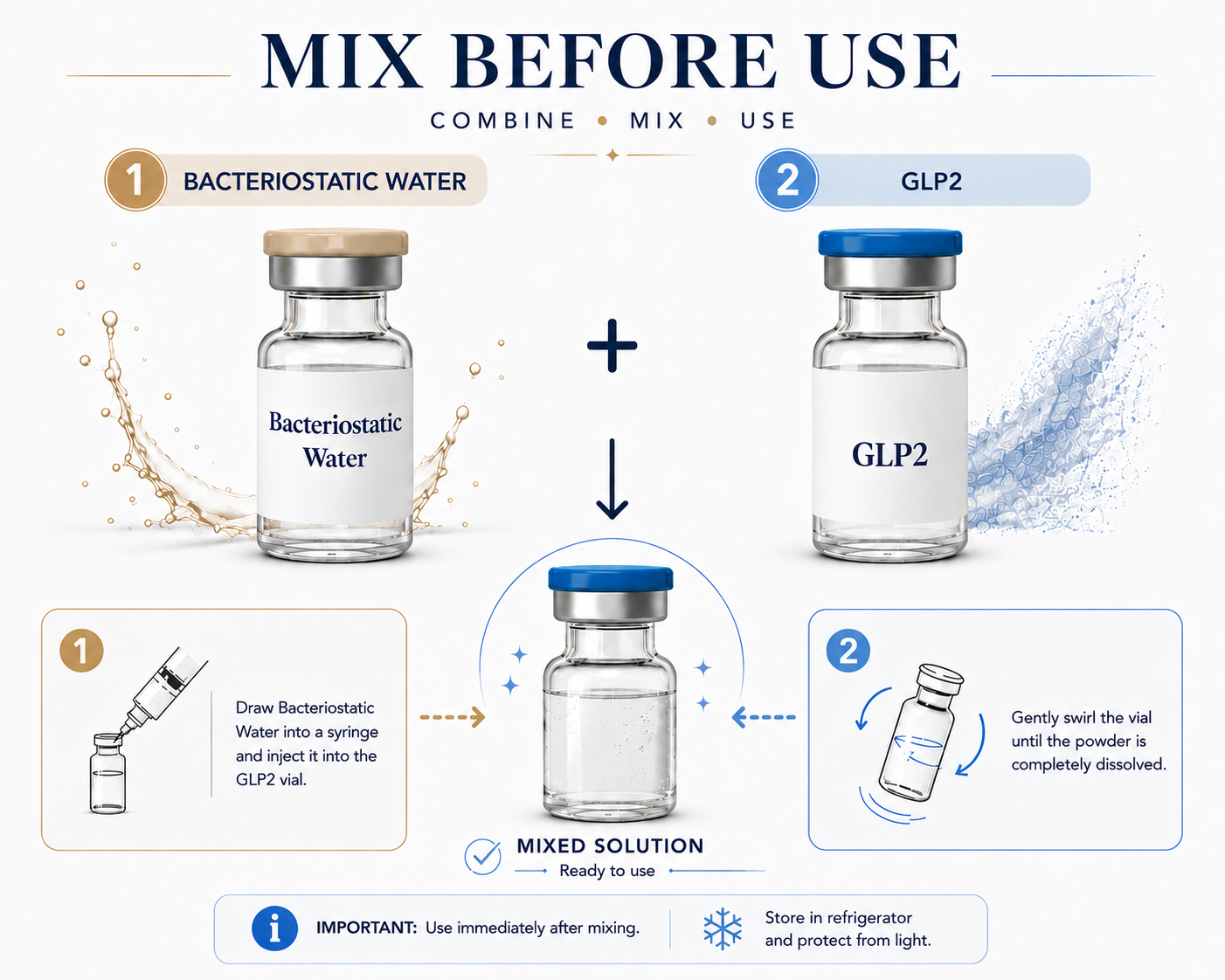
How To Mix GLP2
1
CleanUse alcohol swabs to clean the tops of both vials.
2
Draw BAC WaterDraw the selected amount of bacteriostatic water.
3
Inject SlowlyAdd the liquid slowly down the side of the vial.
4
Swirl GentlyDo not shake. Swirl gently until dissolved.
5
Store ProperlyStore as directed and protect from heat and light.
Best Practices & Common Mistakes
Best Practices
- Use sterile technique.
- Protect from light and heat.
- Store refrigerated when appropriate.
- Use clean syringe-unit math before measuring.
Common Mistakes
- Confusing milligrams with milliliters.
- Choosing an option with awkward decimal units.
- Using too little liquid for very small measurements.
- Shaking the vial aggressively.
GLP2 Storage & Handling
Lyophilized Powder: −20°C (−4°F) for long-term storage (up to 24 months). Refrigeration 2–8°C (36–46°F) for short-term use (up to ~3 months). Original sealed vial in the freezer is safest.
Reconstituted Solution: 2–8°C (36–46°F), use within ~7–14 days. Keep sealed, avoid light, and do not repeat freeze-thaw cycles.
Reconstituted Solution: 2–8°C (36–46°F), use within ~7–14 days. Keep sealed, avoid light, and do not repeat freeze-thaw cycles.
Frequently Asked Questions
Your calculator is a tool for reconstituting powders, not for determining biological rationale. However, a blend is not arbitrary. Pre‑clinical evidence suggests GLP‑2 promotes intestinal growth, which could complement tirzepatide’s metabolic effects, and the dual GLP‑1/GLP‑2 agonist dapiglutide has been evaluated in obesity trials. It is also important to know that GLP‑2 acts via its own receptor (GLP‑2R) and is being developed for short bowel syndrome. A research blend would require its own specific justification, which your calculator cannot provide.
This mismatch means you cannot simply mix a single vial and use it for both protocols. GLP‑2 analogs have been studied at 10 mg twice weekly. Because tirzepatide’s weekly dose is an order of magnitude smaller than a typical GLP‑2 dose, a combination would require a custom, non‑standard ratio. Your calculator can accurately reconstitute powders, but you must treat the blend as a single, new peptide with a unique, fixed dose per injection. The “Doses per vial” will then reflect that new, custom schedule.
For a blend, you must select conditions compatible with both peptides. The solubility of tirzepatide at pH 1.0–5.0 is “insoluble”, but a neutral pH (6.8–11.0) is acceptable. For GLP‑2, a neutral pH is also suitable. Therefore, you should use sterile water or neutral‑pH bacteriostatic water. Do not use an acidic buffer. Your calculator can accept any volume, but the choice of solvent is critical.
The calculator’s “Doses per vial” assumes full potency for the life of the vial, but this is not true for either peptide. GLP‑2, after reconstitution, is stable for only 2 to 7 days when stored at 4 °C. Tirzepatide, when refrigerated, is stable for about 28 days after the first injection. Therefore, for a blend, the limiting stability factor is GLP‑2. The calculator’s “Doses per vial” is a mathematical maximum; for a blend, you must plan to use the entire solution within 7 days or freeze aliquots immediately after reconstitution.
Tirzepatide pens are for single‑patient use and contain a preservative (benzyl alcohol). GLP‑2, when supplied as a powder, is often lyophilised with “no additives”, meaning there is no bacteriostatic agent. If you reconstitute a custom blend vial, you must use bacteriostatic water (BAC water) that contains 0.9% benzyl alcohol. Your calculator can help you compute the volume of BAC water needed. After reconstitution, use aseptic technique (alcohol wipes on the stopper) and refrigerate promptly to maximise sterility and stability.
Practical takeaway: If your real goal is weight or metabolic health, the most useful next step is discussing approved treatment options with a clinician rather than relying on an unapproved compound.
Important: This tool is for informational and research-reference purposes only. Not intended for human or veterinary use.