GDF11 Reconstitution Calculator
Enter the amount you want to measure. The vial buttons will highlight which vial strengths create cleaner syringe-unit measurements.
What amount do you need?
Type the target amount, then choose mg or mcg. Example: 2mg or 500mcg.
Syringe size:
Possible vial strengths:
Best Match
Good Match
Usable
Harder to Measure
Example GDF11 Titration Schedule
| Parameter | Details |
|---|---|
| Dosage | 0.1 mg/kg/day (research) |
| Route | Intraperitoneal (IP) or intravenous (IV) |
| Frequency | Once daily |
| Cycle Length | 2–6 weeks |
| Half‑life | Not established |
| Reconstitution | Sterile water (≥100 µg/mL) |
Possible vial strengths:
What Is It?
GDF11
Growth differentiation factor 11, TGF-β family.
Bacteriostatic Water
Sterile water containing a bacteriostatic preservative, commonly used when preparing multi-use research vials.
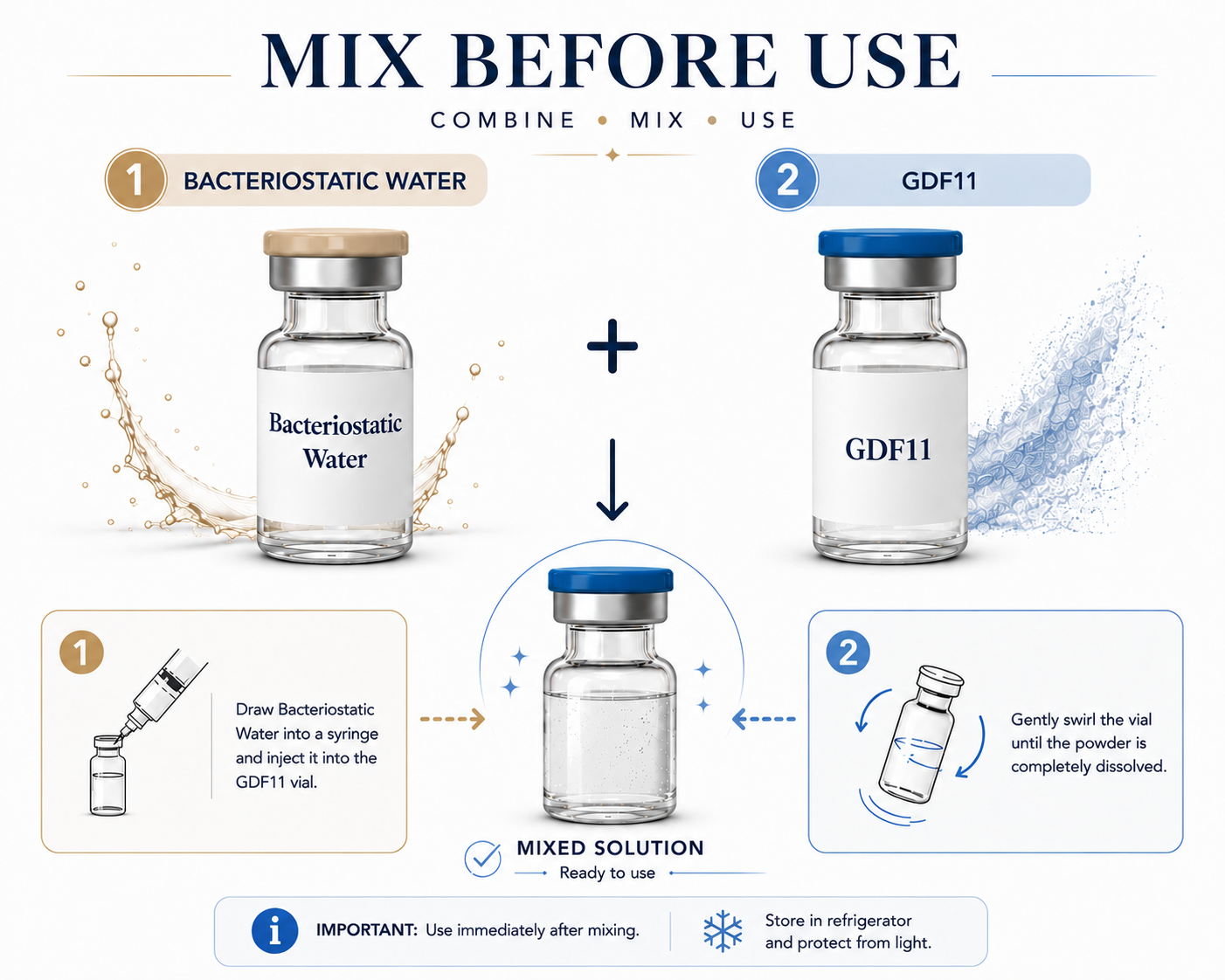
How To Mix GDF11
1
CleanUse alcohol swabs to clean the tops of both vials.
2
Draw BAC WaterDraw the selected amount of bacteriostatic water.
3
Inject SlowlyAdd the liquid slowly down the side of the vial.
4
Swirl GentlyDo not shake. Swirl gently until dissolved.
5
Store ProperlyStore as directed and protect from heat and light.
Best Practices & Common Mistakes
Best Practices
- Use sterile technique.
- Protect from light and heat.
- Store refrigerated when appropriate.
- Use clean syringe-unit math before measuring.
Common Mistakes
- Confusing milligrams with milliliters.
- Choosing an option with awkward decimal units.
- Using too little liquid for very small measurements.
- Shaking the vial aggressively.
GDF11 Storage & Handling
Lyophilized Powder: −20°C (−4°F) for long-term storage (up to 24 months). Refrigeration 2–8°C (36–46°F) for short-term use (up to ~3 months). Original sealed vial in the freezer is safest.
Reconstituted Solution: 2–8°C (36–46°F), use within ~7–14 days. Keep sealed, avoid light, and do not repeat freeze-thaw cycles.
Reconstituted Solution: 2–8°C (36–46°F), use within ~7–14 days. Keep sealed, avoid light, and do not repeat freeze-thaw cycles.
Frequently Asked Questions
Most small peptides have a plasma half‑life of minutes to a few hours. Studies on GDF‑11, however, show its biological half‑life—the time it remains active in the body—is significantly longer, measured at 12 hours. Your calculator likely defaults to a much shorter duration. If you dose GDF‑11 daily based on standard peptide assumptions, you risk over‑exposure or accumulation. Adjust your dosing schedule to account for its unusually prolonged activity window.
The calculator may allow a 28‑day fridge life, but GDF‑11 is fragile. Once reconstituted, the solution is only stable at 4°C for 2 to 7 days. For long‑term storage, you must aliquot and freeze at –20°C, and suppliers strongly recommend adding a carrier protein (0.1% HSA or BSA) to prevent degradation and avoid freeze‑thaw cycles. Ignoring this can degrade your peptide before your experiment even starts.
Your calculator’s linear dose scaling can be fatal for GDF‑11. A dose of 1 mg/kg/day is common and well‑tolerated, producing beneficial effects without apparent toxicity. However, increasing the dose to just 5 mg/kg causes severe cachexia (wasting) in mice, forcing humane sacrifice within ten days. The therapeutic window is narrow—dosing must be precise. This makes accurate weighing and reconstitution critical; errors can shift you into the toxic range.
For subcutaneous studies, you can usually follow the calculator’s recommended solubility.
If your protocol calls for intravenous (IV) administration, research on stroke models suggests a specific regimen: 1 mg/kg every 48 hours, for a total of three doses.
Furthermore, suppliers require a minimum solubility of 100 µg/mL for proper dissolution, a level your calculator’s default numbers might not meet.
If your protocol calls for intravenous (IV) administration, research on stroke models suggests a specific regimen: 1 mg/kg every 48 hours, for a total of three doses.
Furthermore, suppliers require a minimum solubility of 100 µg/mL for proper dissolution, a level your calculator’s default numbers might not meet.
This is the most critical nuance the calculator can’t capture. While many studies show anti‑aging benefits for the heart and brain, the rejuvenating effects on skeletal muscle are hotly disputed. The field remains highly controversial. A major issue is that early antibodies used to detect GDF‑11 were found to cross‑react with myostatin (a different, abundant protein), potentially rendering some foundational data unreliable. The subject’s age and your specific source of recombinant GDF‑11 may influence your results as much as the injected dose.
Practical takeaway: If your real goal is weight or metabolic health, the most useful next step is discussing approved treatment options with a clinician rather than relying on an unapproved compound.
Important: This tool is for informational and research-reference purposes only. Not intended for human or veterinary use.