AOD9604 Reconstitution Calculator
Enter the amount you want to measure. The vial buttons will highlight which vial strengths create cleaner syringe-unit measurements.
What amount do you need?
Type the target amount, then choose mg or mcg. Example: 2mg or 500mcg.
Syringe size:
Possible vial strengths:
Best Match
Good Match
Usable
Harder to Measure
Example AOD9604 Titration Schedule
| Dose | 100–500 mcg per dose |
|---|---|
| Frequency | Daily |
| Cycle Length | 60–90 days (commonly listed) or up to 180 days (continuous) |
| Break Between Cycles | 30-day minimum cycle break |
| Timing Tip | Often suggested on an empty stomach in the morning or before a workout |
Possible vial strengths:
What Is It?
AOD9604
Modified hGH fragment investigated for fat metabolism.
Bacteriostatic Water
Sterile water containing a bacteriostatic preservative, commonly used when preparing multi-use research vials.
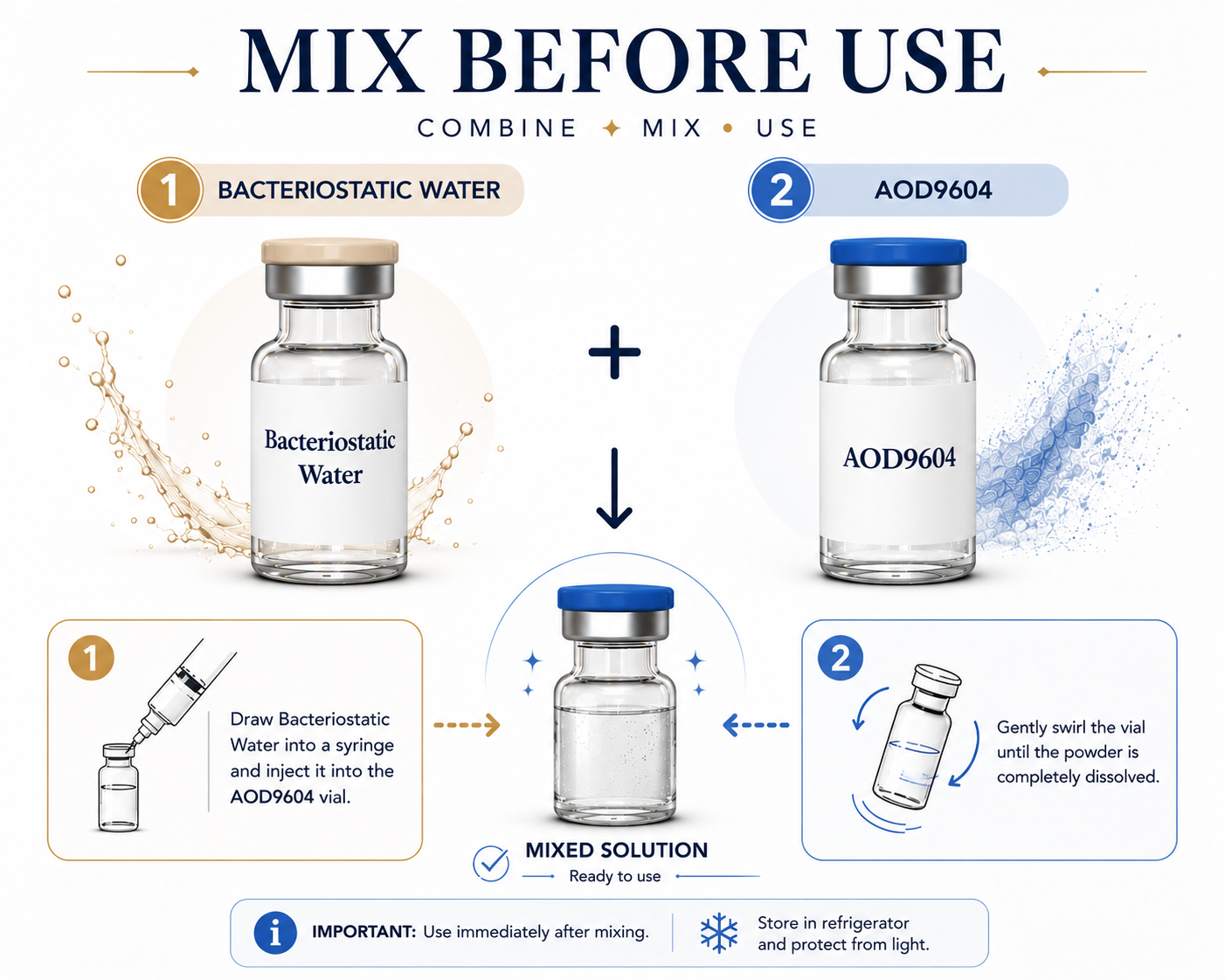
How To Mix AOD9604
1
CleanUse alcohol swabs to clean the tops of both vials.
2
Draw BAC WaterDraw the selected amount of bacteriostatic water.
3
Inject SlowlyAdd the liquid slowly down the side of the vial.
4
Swirl GentlyDo not shake. Swirl gently until dissolved.
5
Store ProperlyStore as directed and protect from heat and light.
Best Practices & Common Mistakes
Best Practices
- Use sterile technique.
- Protect from light and heat.
- Store refrigerated when appropriate.
- Use clean syringe-unit math before measuring.
Common Mistakes
- Confusing milligrams with milliliters.
- Choosing an option with awkward decimal units.
- Using too little liquid for very small measurements.
- Shaking the vial aggressively.
AOD9604 Storage & Handling
Lyophilized Powder: −20°C (−4°F) for long-term storage (up to 24 months). Refrigeration 2–8°C (36–46°F) for short-term use (up to ~3 months). Original sealed vial in the freezer is safest.
Reconstituted Solution: 2–8°C (36–46°F), use within ~7–14 days. Keep sealed, avoid light, and do not repeat freeze-thaw cycles.
Reconstituted Solution: 2–8°C (36–46°F), use within ~7–14 days. Keep sealed, avoid light, and do not repeat freeze-thaw cycles.
Frequently Asked Questions
Simply convert your mcg dose to milligrams: divide by 1000. For example, a typical dose of 300 mcg = 0.3 mg. Enter 0.3 in the “Desired dose” field. The calculator works with decimals. Then select your syringe, vial strength, and BAC volume – it will show the required units. Always double‑check that you entered mg, not mcg (e.g., 300 mg would be 1000× too high).
With 5 mg in 1 mL, concentration = 5 mg/mL. For 0.3 mg, volume = 0.06 mL = 6 units on a 100‑unit syringe. That is above the calculator’s “poor” threshold (≥4 units), so it might be “Usable” or “Good” depending on rounding. However, if you use a 30‑unit syringe, 6 units is still acceptable. “Poor” appears when the required units are below 4 (too small to measure accurately) or when the units don’t fall on a whole/half mark. For AOD9604, try using 2 or 3 mL of BAC water to increase the draw volume – e.g., 5 mg in 2 mL = 2.5 mg/mL, 0.3 mg = 0.12 mL = 12 units, which is more accurate.
For a 0.3 mg dose on a 100‑unit syringe, the best vials are those that give a round number of units (multiple of 5). Example: using 2 mL BAC water –
5 mg vial → 2.5 mg/mL → 0.3 mg = 0.12 mL = 12 units (not a multiple of 5, but usable).
10 mg vial → 5 mg/mL → 0.3 mg = 0.06 mL = 6 units (again, not ×5).
6 mg vial → 3 mg/mL → 0.3 mg = 0.10 mL = 10 units (multiple of 5 → Best).
The calculator will highlight the best matches. Experiment with different BAC volumes to improve accuracy.
5 mg vial → 2.5 mg/mL → 0.3 mg = 0.12 mL = 12 units (not a multiple of 5, but usable).
10 mg vial → 5 mg/mL → 0.3 mg = 0.06 mL = 6 units (again, not ×5).
6 mg vial → 3 mg/mL → 0.3 mg = 0.10 mL = 10 units (multiple of 5 → Best).
The calculator will highlight the best matches. Experiment with different BAC volumes to improve accuracy.
No, the calculator only performs dilution math. It does not track time, temperature, or peptide stability. For AOD9604, once reconstituted with bacteriostatic water, it is typically stored refrigerated (2–8°C) and used within 30 days. The “Doses per vial” display helps you plan how many doses you will draw – do not keep the vial longer than recommended for your specific peptide.
The calculator assumes a single peptide in the vial. If you mix two peptides (e.g., AOD9604 and another), the total mass in mg is the sum, but the required dose for each peptide separately will be different. You cannot get both doses from one calculation. For a mixed vial, calculate the concentration for each peptide based on its individual mg in the vial and the total BAC volume. Use the calculator for one peptide at a time, or manually compute the units for the second peptide using the same concentration factor.
Practical takeaway: If your real goal is weight or metabolic health, the most useful next step is discussing approved treatment options with a clinician rather than relying on an unapproved compound.
Important: This tool is for informational and research-reference purposes only. Not intended for human or veterinary use.