Amycretin Reconstitution Calculator
Enter the amount you want to measure. The vial buttons will highlight which vial strengths create cleaner syringe-unit measurements.
What amount do you need?
Type the target amount, then choose mg or mcg. Example: 2mg or 500mcg.
Syringe size:
Possible vial strengths:
Best Match
Good Match
Usable
Harder to Measure
Example Amycretin Titration Schedule
| Parameter | Details |
|---|---|
| Dosage (SC injection) | Escalate from 0.3 mg to 20–60 mg once weekly |
| Dosage (Oral tablet) | Escalate from 3 mg to 100 mg (2×50 mg) once daily |
| Route | Subcutaneous (SC) or oral |
| Frequency | Once weekly (injection) / Once daily (oral) |
| Cycle Length | Up to 36 weeks (clinical trials) |
| Reconstitution (research use) | Dissolve in DMSO, then dilute with PEG300/Tween 80/saline for injection |
Possible vial strengths:
What Is It?
Amycretin
GLP-1 / amylin dual agonist under study.
Bacteriostatic Water
Sterile water containing a bacteriostatic preservative, commonly used when preparing multi-use research vials.
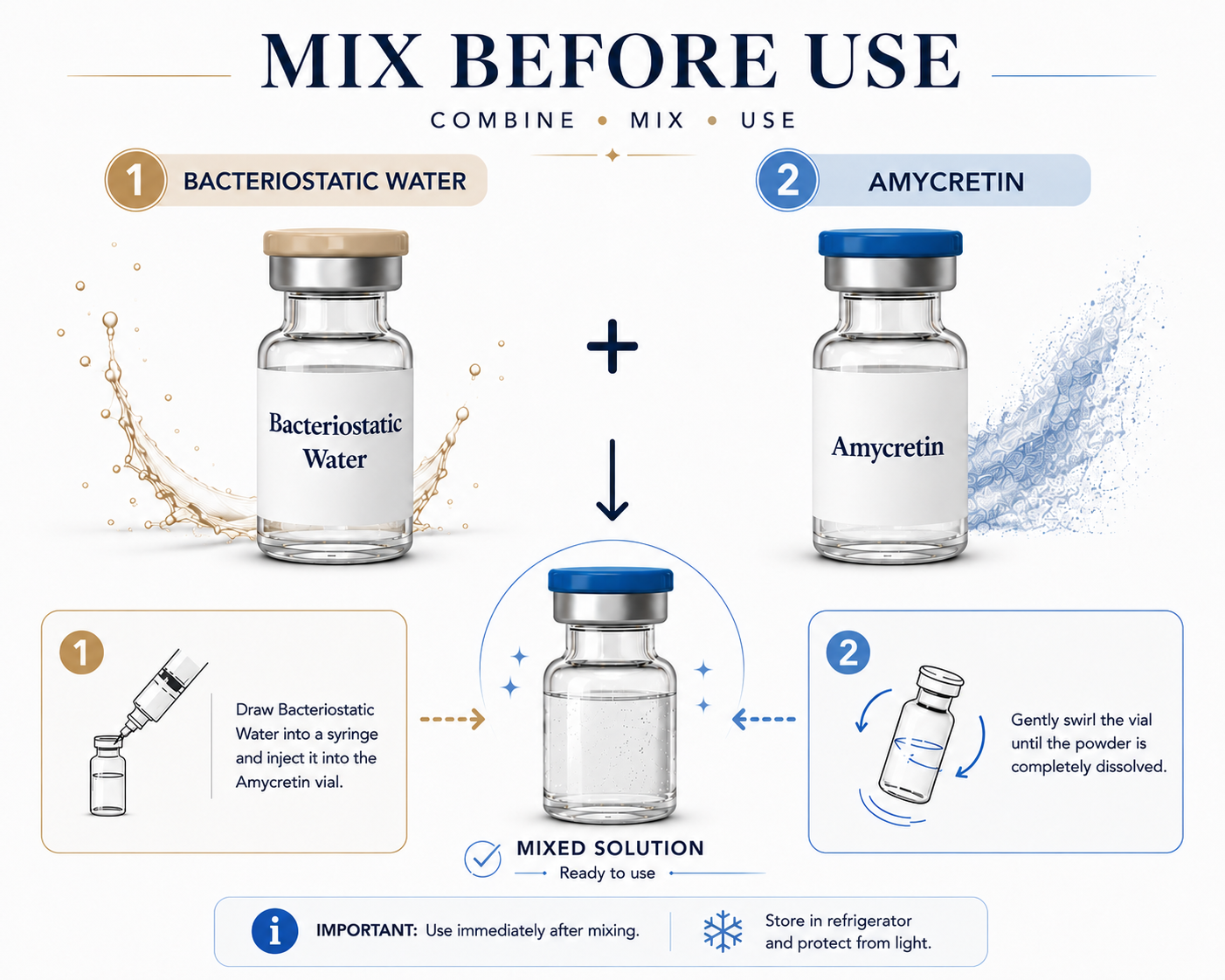
How To Mix Amycretin
1
CleanUse alcohol swabs to clean the tops of both vials.
2
Draw BAC WaterDraw the selected amount of bacteriostatic water.
3
Inject SlowlyAdd the liquid slowly down the side of the vial.
4
Swirl GentlyDo not shake. Swirl gently until dissolved.
5
Store ProperlyStore as directed and protect from heat and light.
Best Practices & Common Mistakes
Best Practices
- Use sterile technique.
- Protect from light and heat.
- Store refrigerated when appropriate.
- Use clean syringe-unit math before measuring.
Common Mistakes
- Confusing milligrams with milliliters.
- Choosing an option with awkward decimal units.
- Using too little liquid for very small measurements.
- Shaking the vial aggressively.
Amycretin Storage & Handling
Lyophilized Powder: −20°C (−4°F) for long-term storage (up to 24 months). Refrigeration 2–8°C (36–46°F) for short-term use (up to ~3 months). Original sealed vial in the freezer is safest.
Reconstituted Solution: 2–8°C (36–46°F), use within ~7–14 days. Keep sealed, avoid light, and do not repeat freeze-thaw cycles.
Reconstituted Solution: 2–8°C (36–46°F), use within ~7–14 days. Keep sealed, avoid light, and do not repeat freeze-thaw cycles.
Frequently Asked Questions
The pharmacokinetic profile of amycretin is highly formulation‑dependent. The subcutaneous formulation is designed for once‑weekly administration with a long half‑life that supports weekly escalation from 0.3 mg up to 60 mg. In contrast, the oral formulation requires once‑daily dosing due to its different absorption kinetics, with doses ranging from 6 mg to 50 mg. Using the calculator for one formulation while following the dosing regimen of the other will severely mis‑estimate plasma levels and the cumulative dose.
Amycretin is a large 7846.6 Da peptide that is acylated with a C18 diacid attached to a lysine via a γ‑Glu‑AEEA‑AEEA spacer. This hydrophobic tail makes the peptide poorly soluble in plain water; in DMSO the solubility is only 2 mg/mL even with ultrasonication. Attempting to dissolve it directly in BAC water at the concentration suggested by the calculator will likely result in a cloudy or precipitated solution, leading to inaccurate dosing.
The oral formulation of amycretin contains salcaprozate sodium (SNAC) as a permeation enhancer to achieve adequate bioavailability. This excipient is not present in the lyophilized powder intended for injection. If you reconstitute the subcutaneous powder and attempt to use it orally without SNAC, absorption will be negligible regardless of the volume calculated.
Because of the C18 fatty acid chain, amycretin is prone to aggregation in aqueous solution, especially at high concentrations or with repeated temperature changes. Short‑term storage at 4 °C is acceptable for only 1‑2 weeks; for longer storage, the solution must be aliquoted and frozen at –20 °C (stable for 12 months) or –80 °C, and repeated freeze‑thaw cycles must be strictly avoided. The calculator’s default assumption of indefinite stability at 4 °C is unsafe for this peptide.
Gastrointestinal side effects (nausea, vomiting, diarrhea) are the most common adverse events with amycretin and increase in a dose‑dependent manner. In clinical trials, withdrawals unrelated to treatment‑emergent adverse events were also high. The calculator cannot predict an individual’s tolerability; starting with the lowest planned dose and following a slow escalation schedule is essential to manage side effects, irrespective of the mathematically “correct” volume.
Practical takeaway: If your real goal is weight or metabolic health, the most useful next step is discussing approved treatment options with a clinician rather than relying on an unapproved compound.
Important: This tool is for informational and research-reference purposes only. Not intended for human or veterinary use.