ACE-031 Reconstitution Calculator
Enter the amount you want to measure. The vial buttons will highlight which vial strengths create cleaner syringe-unit measurements.
What amount do you need?
Type the target amount, then choose mg or mcg. Example: 2mg or 500mcg.
Syringe size:
Possible vial strengths:
Best Match
Good Match
Usable
Harder to Measure
Example ACE-031 Titration Schedule
| Parameter | Details |
|---|---|
| Clinical Study Dosages | 0.02 to 3 mg/kg |
| Clinical Study Regimen | Once every 2 to 4 weeks |
| Research Model Regimen (Primate) | 3 mg/kg, once weekly, for up to 14 weeks |
| Route of Administration | Subcutaneous (SC) injection |
| Clinical Cycle Length | 12 weeks for Phase 2 study |
| Typical Research Cycle | 4–6 weeks (dependent on study endpoint) |
| Half‑Life | 10–15 days |
| Onset of Effect | Increased lean mass observed within 15–29 days |
| Reconstitution | Sterile PBS or saline |
| Storage (Lyophilized) | −20°C (stable for up to 3 years) |
| Storage (Reconstituted) | −80°C (up to 6 months); or −20°C (up to 1 month) |
| Additional Handling | Avoid repeated freeze-thaw cycles; add carrier protein (0.1% HSA or BSA) for long-term storage |
Possible vial strengths:
What Is It?
ACE-031
Activin receptor IIB fusion studied for muscle research.
Bacteriostatic Water
Sterile water containing a bacteriostatic preservative, commonly used when preparing multi-use research vials.
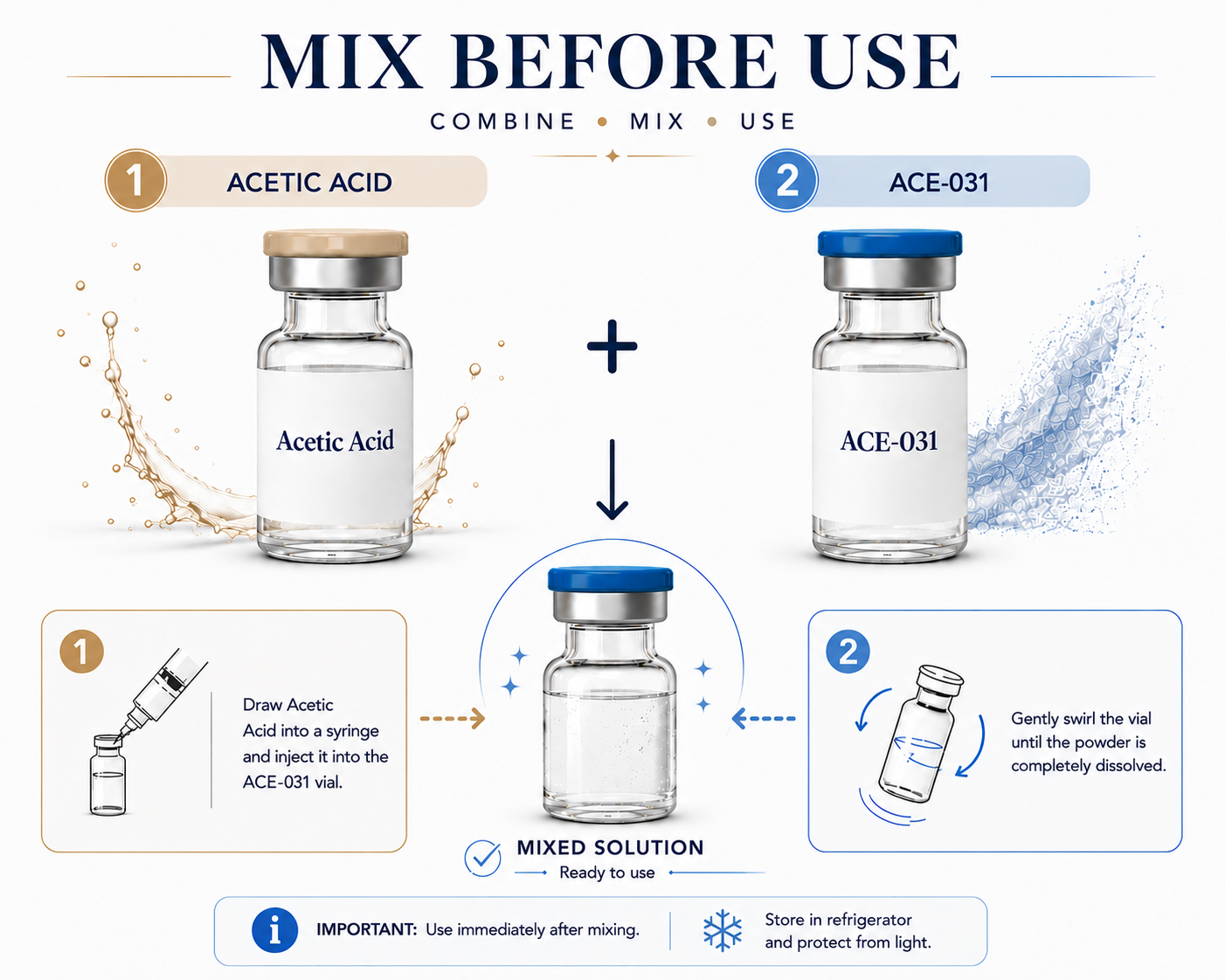
How To Mix ACE-031
1
CleanUse alcohol swabs to clean the tops of both vials.
2
Draw BAC WaterDraw the selected amount of bacteriostatic water.
3
Inject SlowlyAdd the liquid slowly down the side of the vial.
4
Swirl GentlyDo not shake. Swirl gently until dissolved.
5
Store ProperlyStore as directed and protect from heat and light.
Best Practices & Common Mistakes
Best Practices
- Use sterile technique.
- Protect from light and heat.
- Store refrigerated when appropriate.
- Use clean syringe-unit math before measuring.
Common Mistakes
- Confusing milligrams with milliliters.
- Choosing an option with awkward decimal units.
- Using too little liquid for very small measurements.
- Shaking the vial aggressively.
ACE-031 Storage & Handling
Lyophilized Powder: −20°C (−4°F) for long-term storage (up to 24 months). Refrigeration 2–8°C (36–46°F) for short-term use (up to ~3 months). Original sealed vial in the freezer is safest.
Reconstituted Solution: 2–8°C (36–46°F), use within ~7–14 days. Keep sealed, avoid light, and do not repeat freeze-thaw cycles.
Reconstituted Solution: 2–8°C (36–46°F), use within ~7–14 days. Keep sealed, avoid light, and do not repeat freeze-thaw cycles.
Frequently Asked Questions
Your calculator is wrong for this compound. In the single ascending-dose study (0.02-3 mg/kg SC), the mean terminal half-life was 10-15 days. This long half-life supports subcutaneous dosing once every 2-4 weeks, not daily or weekly as your tool assumes.
Because it's a large 77.24 kDa fusion protein, not a small peptide. Suppliers recommend reconstituting with sterile PBS or saline, not BAC water alone. Some research-grade products specifically note reconstitution with BAC water for best results, but sterile PBS is the clinical standard.
The reconstituted solution is stable for up to 28 days at 2-8°C under sterile conditions. For longer storage, a manufacturer advises storing at −80°C (6 months) or −20°C (1 month). Your calculator's "freeze after 30 days" rule may not apply if you use −80°C storage.
Your calculator assumes a single target. ACE-031 binds and neutralizes myostatin and other negative regulators of muscle mass. This broader activity means the biological effect per mg is not directly comparable to a pure myostatin inhibitor. A dose that saturates myostatin may not fully neutralize activin A.
Fc-fusion proteins are inherently more stable than standard peptides in lyophilized form. The lyophilized powder is stable for up to 3 years at -20°C. Your calculator's generic 2-year stability default may underestimate the actual shelf life of the unopened powder.
Practical takeaway: If your real goal is weight or metabolic health, the most useful next step is discussing approved treatment options with a clinician rather than relying on an unapproved compound.
Important: This tool is for informational and research-reference purposes only. Not intended for human or veterinary use.