YK-11 Reconstitution Calculator
Enter the amount you want to measure. The vial buttons will highlight which vial strengths create cleaner syringe-unit measurements.
What amount do you need?
Type the target amount, then choose mg or mcg. Example: 2mg or 500mcg.
Syringe size:
Possible vial strengths:
Best Match
Good Match
Usable
Harder to Measure
Example YK-11 Titration Schedule
| Parameter | Details |
|---|---|
| Dosage | 2–20 mg/day (common: 5–10 mg/day) |
| Route | Oral |
| Frequency | 2 times per day (due to short half-life) |
| Cycle Length | 4–8 weeks, then 4 weeks off |
| Half‑life | 6–10 hours |
| Reconstitution | Not applicable (oral) |
Possible vial strengths:
What Is It?
YK-11
Myostatin pathway research compound.
Bacteriostatic Water
Sterile water containing a bacteriostatic preservative, commonly used when preparing multi-use research vials.
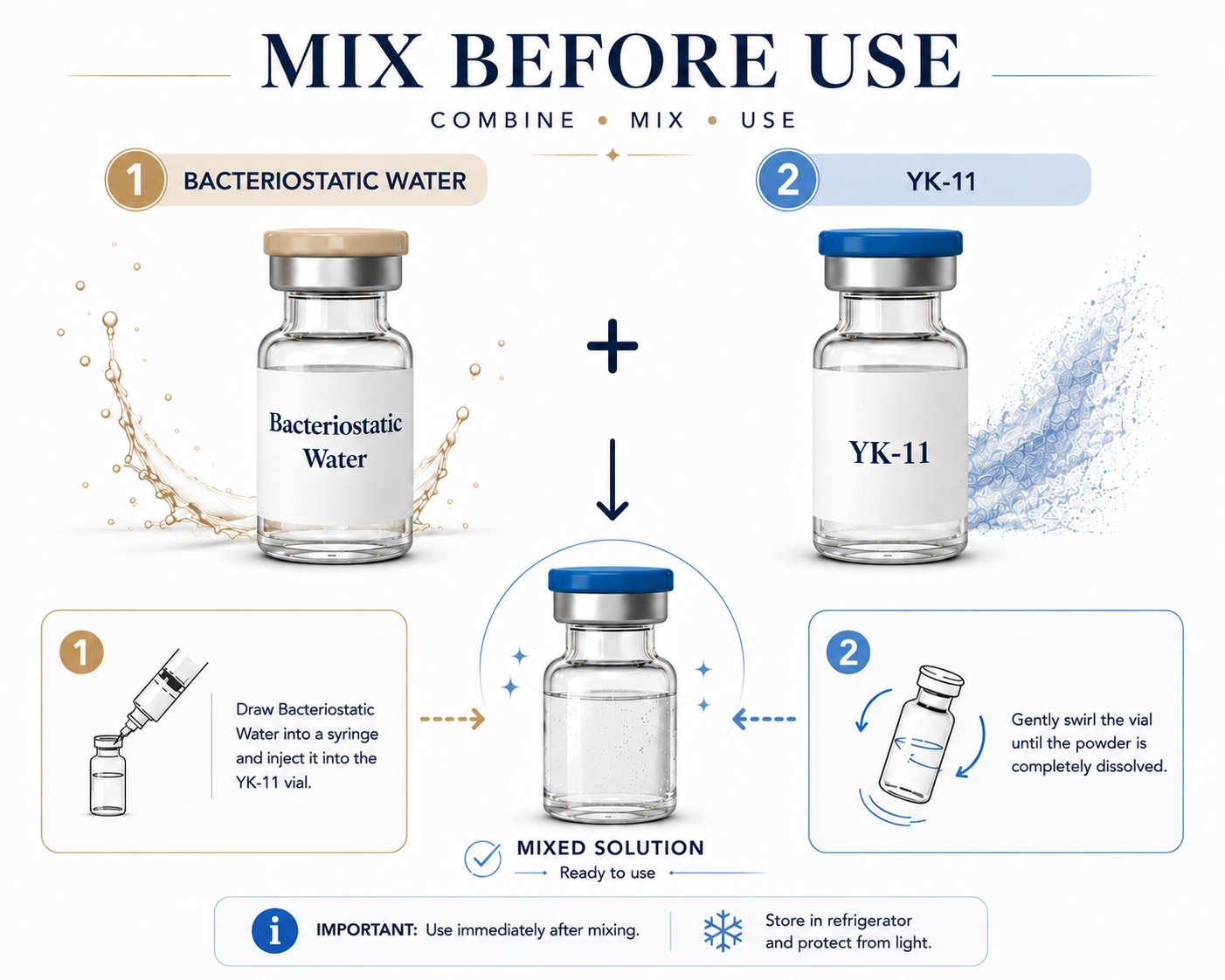
How To Mix YK-11
1
CleanUse alcohol swabs to clean the tops of both vials.
2
Draw BAC WaterDraw the selected amount of bacteriostatic water.
3
Inject SlowlyAdd the liquid slowly down the side of the vial.
4
Swirl GentlyDo not shake. Swirl gently until dissolved.
5
Store ProperlyStore as directed and protect from heat and light.
Best Practices & Common Mistakes
Best Practices
- Use sterile technique.
- Protect from light and heat.
- Store refrigerated when appropriate.
- Use clean syringe-unit math before measuring.
Common Mistakes
- Confusing milligrams with milliliters.
- Choosing an option with awkward decimal units.
- Using too little liquid for very small measurements.
- Shaking the vial aggressively.
YK-11 Storage & Handling
Lyophilized Powder: −20°C (−4°F) for long-term storage (up to 24 months). Refrigeration 2–8°C (36–46°F) for short-term use (up to ~3 months). Original sealed vial in the freezer is safest.
Reconstituted Solution: 2–8°C (36–46°F), use within ~7–14 days. Keep sealed, avoid light, and do not repeat freeze-thaw cycles.
Reconstituted Solution: 2–8°C (36–46°F), use within ~7–14 days. Keep sealed, avoid light, and do not repeat freeze-thaw cycles.
Frequently Asked Questions
The calculator assumes water solubility (≥0.1 mg/mL is a typical baseline). However, YK-11 is a hydrophobic steroidal SARM and is practically insoluble in water. A validated in-vivo injectable vehicle is a multi‑step process using 10% DMSO, 40% PEG300, 5% Tween‑80, and 45% saline (yield: a clear solution at ≥2.5 mg/mL). Just adding BAC water will simply leave the powder floating in the vial.
The calculator's default once‑daily schedule can't be followed for YK-11 because its active half‑life is short (6–10 hours), largely due to the 'first‑pass' effect in the liver. Therefore, the total daily dose must be split into two equal injections, spaced 8–12 hours apart, to maintain more consistent levels.
The calculator assumes a simple, linear dose‑response curve. YK-11 acts via "gene‑selective" partial agonism of the androgen receptor. It does not induce the physical interaction between the receptor's structural domains (NTD/AF1 and LBD/AF2), which is needed for 'full' activation. Therefore, it acts only on specific subsets of AR target genes, so the calculated effect does not scale linearly with mass.
The calculator assumes safety is purely dose‑dependent. However, a recent study revealed that at anabolic doses, YK-11 induces oxidative stress and mitochondrial dysfunction in the hippocampus, leading to impairments in memory consolidation. Even at a "correctly" calculated dose, YK-11 has been shown to have potentially significant neurological risks, an effect the calculator could not predict from mass alone.
Your calculator is designed for peptides, but YK-11 powder is much more stable. Unopened, it can be stored for 2 years at –20°C. A solution in DMSO (the preferred stock solvent) is stable for 6 months at –80°C, but for only 2 weeks at 4°C. The calculator's generic 28‑day refrigeration rule would lead to significant degradation of an already prepared stock.
Practical takeaway: If your real goal is weight or metabolic health, the most useful next step is discussing approved treatment options with a clinician rather than relying on an unapproved compound.
Important: This tool is for informational and research-reference purposes only. Not intended for human or veterinary use.