PNC-27 Reconstitution Calculator
Enter the amount you want to measure. The vial buttons will highlight which vial strengths create cleaner syringe-unit measurements.
What amount do you need?
Type the target amount, then choose mg or mcg. Example: 2mg or 500mcg.
Syringe size:
Possible vial strengths:
Best Match
Good Match
Usable
Harder to Measure
Example PNC-27 Titration Schedule
| Protocol Item | Guidance |
|---|---|
| Dose | 200–500 mcg per dose |
| Cycling | Daily for 30-day cycles (or shorter), with a 30-day minimum cycle break between |
| Response-Based Adjustment | Dosing intensity/frequency depends on individual goal and response |
Possible vial strengths:
What Is It?
PNC-27
p53-derived peptide in oncology research.
Bacteriostatic Water
Sterile water containing a bacteriostatic preservative, commonly used when preparing multi-use research vials.
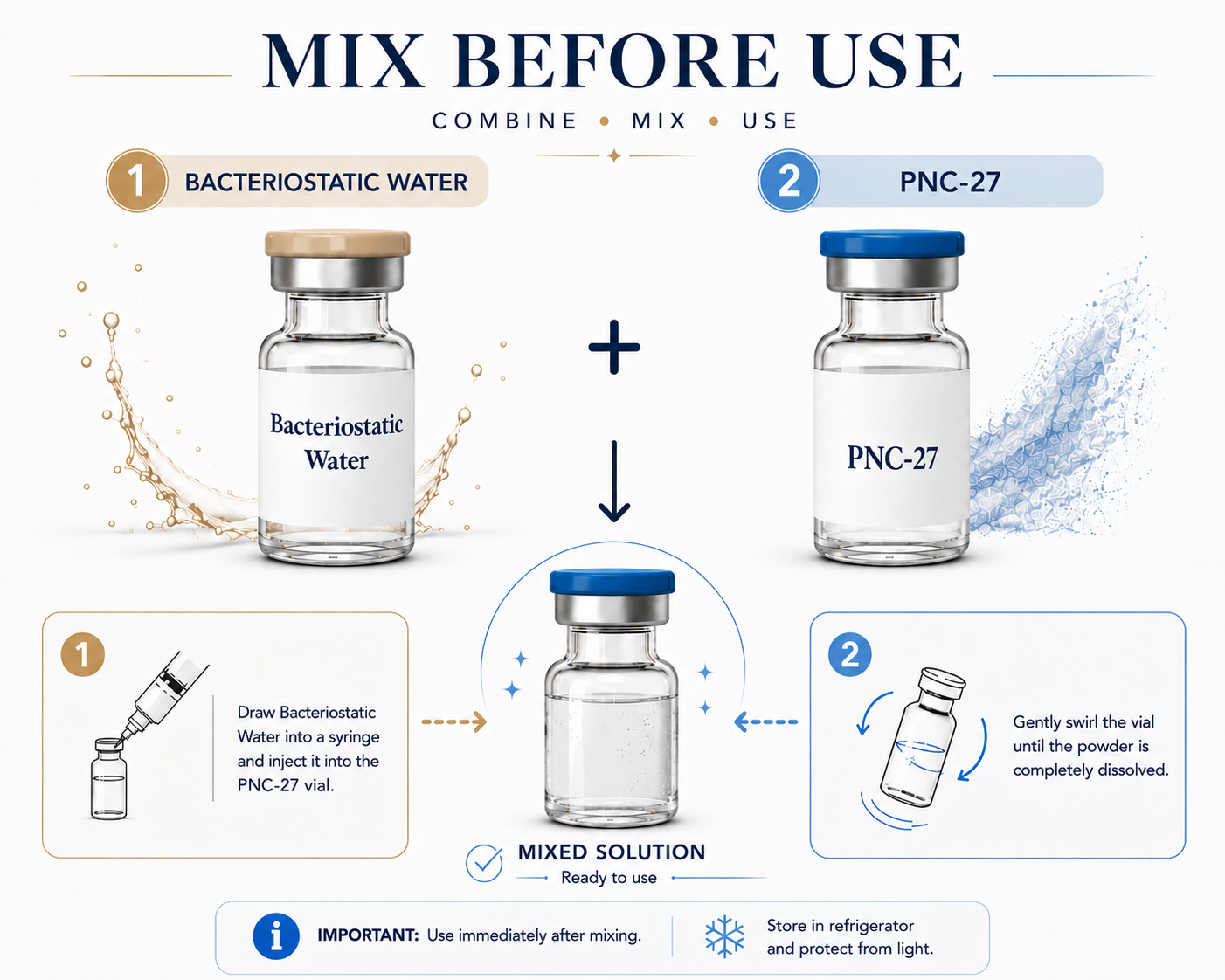
How To Mix PNC-27
1
CleanUse alcohol swabs to clean the tops of both vials.
2
Draw BAC WaterDraw the selected amount of bacteriostatic water.
3
Inject SlowlyAdd the liquid slowly down the side of the vial.
4
Swirl GentlyDo not shake. Swirl gently until dissolved.
5
Store ProperlyStore as directed and protect from heat and light.
Best Practices & Common Mistakes
Best Practices
- Use sterile technique.
- Protect from light and heat.
- Store refrigerated when appropriate.
- Use clean syringe-unit math before measuring.
Common Mistakes
- Confusing milligrams with milliliters.
- Choosing an option with awkward decimal units.
- Using too little liquid for very small measurements.
- Shaking the vial aggressively.
PNC-27 Storage & Handling
Lyophilized Powder: −20°C (−4°F) for long-term storage (up to 24 months). Refrigeration 2–8°C (36–46°F) for short-term use (up to ~3 months). Original sealed vial in the freezer is safest.
Reconstituted Solution: 2–8°C (36–46°F), use within ~7–14 days. Keep sealed, avoid light, and do not repeat freeze-thaw cycles.
Reconstituted Solution: 2–8°C (36–46°F), use within ~7–14 days. Keep sealed, avoid light, and do not repeat freeze-thaw cycles.
Frequently Asked Questions
No, and this is a critical limitation of the calculator for this peptide. PNC‑27 binds to HDM‑2 proteins on cancer cell membranes, causing pore formation and membrane lysis. For pore‑forming peptides, there is often a concentration threshold below which no pores form, and above which killing is rapid and nearly complete. Data from a colon cancer study show that PNC‑27's cell‑killing activity is highly concentration‑dependent and rapid, with cell death occurring within four hours at higher doses. The calculator will linearly scale the volume for a dose increase, but the biological effect of a 40 mg/kg dose may not be twice that of a 20 mg/kg dose. Pore formation is a threshold phenomenon: below the minimum effective concentration (MEC), the peptide likely has no activity at all.
PNC‑27 has a uniquely defined solubility window that your calculator cannot see. Multiple suppliers recommend reconstituting the lyophilised peptide in sterile water at a concentration not less than 100 µg/mL. However, PNC‑27 is also highly soluble in water at concentrations up to or exceeding 100 mg/mL. The calculator can mathematically produce a concentration of 10 mg/mL, which falls within the acceptable solubility window, but it cannot warn you if you choose a volume that results in a concentration below 0.1 mg/mL. If you use too much BAC water (e.g., 100 mL for a 5 mg vial), the final concentration will be too low for the peptide to stay dissolved, leading to a cloudy solution and unpredictable dosing. Always ensure the final concentration is at least 100 µg/mL or above the manufacturer's lower solubility limit.
The calculator's "doses per vial" count is a mathematical maximum based on mass. The data sheet for PNC‑27 states that the lyophilised powder is stable for up to 3 weeks at room temperature, but for extended storage it should be stored desiccated below -18 °C. Upon reconstitution, PNC‑27 should be stored at 4 °C for between 2 and 7 days. For long‑term storage, adding a carrier protein like 0.1% HSA or BSA is recommended. If the calculator shows 30 "doses per vial" for a low‑dose protocol, you will never be able to use all 30 doses from a single vial, because the peptide will degrade within a week. Therefore, you must calculate how many doses you will use within the 2‑7 day window and plan to reconstitute only that amount, or freeze aliquots for use after the window closes.
The calculator assumes that bacteriostatic water is a safe, inert diluent for all peptides. However, PNC‑27 contains a methionine residue (Met) in its 32‑amino‑acid sequence. Methionine is highly susceptible to oxidation, especially in the presence of preservatives like benzyl alcohol, which is present in standard bacteriostatic water. This oxidation can reduce the peptide's biological activity. For this reason, some suppliers specifically recommend reconstituting PNC‑27 in sterile 18MΩ‑cm H₂O (ultrapure water), not bacteriostatic water. If you use the calculator's default BAC water, you may inadvertently degrade your peptide, especially if storing it for more than 24 hours. For maximal stability and activity, use sterile water and discard any unused solution after 24 hours, or follow the specific storage guidelines for your batch.
The calculator is a mathematical dilution tool, but it cannot bridge this pharmacological gap. The 50 µg/mL concentration is highly effective in cell culture, causing 100% cell death within 90 minutes. In living animals, a 40 mg/kg intraperitoneal dose administered daily for 2‑3 weeks is required to achieve anti‑tumour activity. For a 70 kg human research subject, 40 mg/kg corresponds to a daily dose of 2,800 mg per day, which is far beyond the calculator’s vial strength presets. The calculator will produce a volume for any entered mass, but if a researcher mistakenly uses the in‑vitro 50 µg dose in an animal study, the dose will be 800‑fold too low and have no effect. You must determine the correct dose for your specific experimental model from the literature, not from the calculator's convenience.
Practical takeaway: If your real goal is weight or metabolic health, the most useful next step is discussing approved treatment options with a clinician rather than relying on an unapproved compound.
Important: This tool is for informational and research-reference purposes only. Not intended for human or veterinary use.