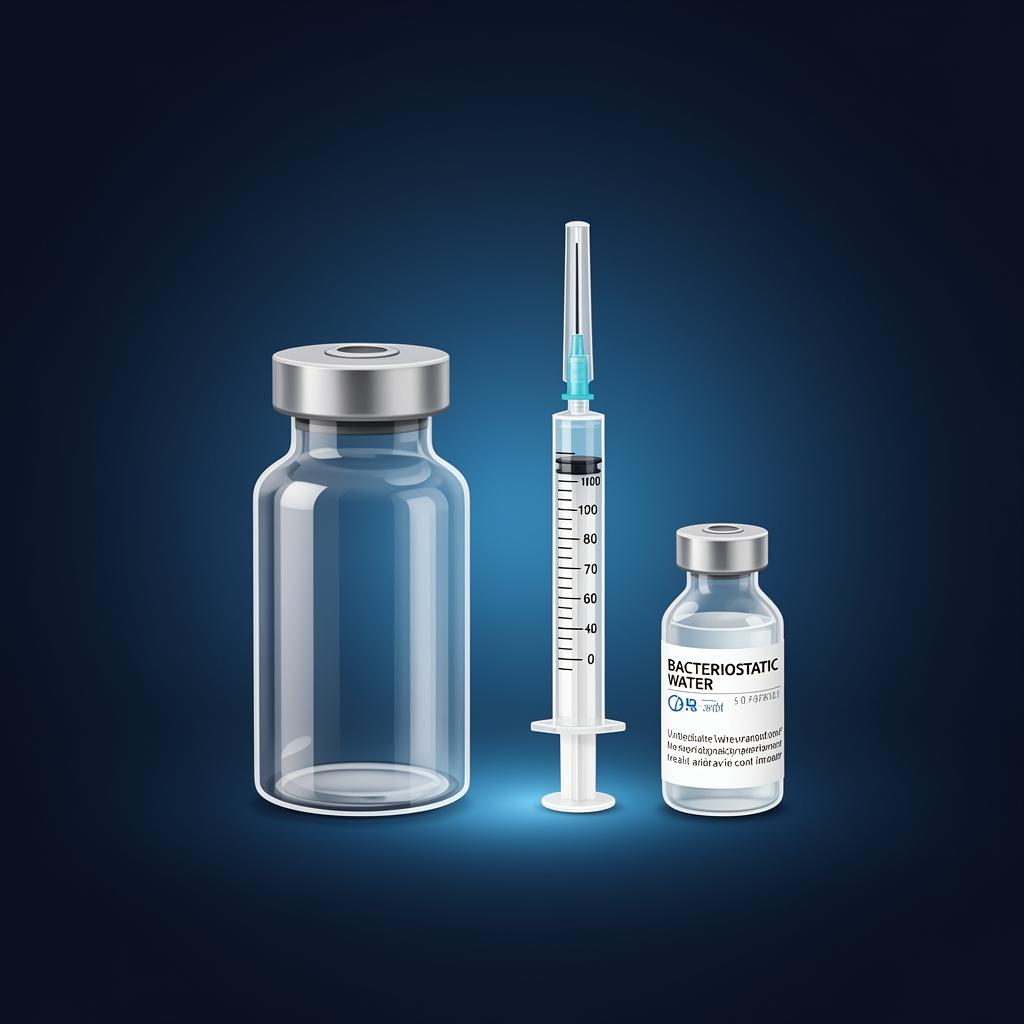
If a vial says 5mg and you have 2mL of BAC water, the hard part isn't the math — it's knowing what each number actually means. A peptide reconstitution calculator takes vial strength, BAC water volume, and a target research amount, and gives you one clear number on a U-100 syringe.
Open the Peptide Calculator → Enter vial strength, BAC water volume, and your target research amount.
What This Means in Simple Terms
A peptide vial holds dry powder. You add BAC water to dissolve it. That gives you a concentration — how much peptide is in each mL of liquid. The calculator reads that concentration and tells you what syringe mark to draw to for the research amount you typed in.
No formulas to memorize. No unit gymnastics. Just three inputs, one answer.
What You Need Before You Calculate
- Vial strength — the dry peptide weight on the label (2mg, 5mg, 10mg, 20mg, 50mg, 100mg).
- BAC water volume — how much bacteriostatic water you added (usually 1mL, 2mL, or 3mL).
- Target research amount — the calculation amount per draw, in mcg or mg.
- Syringe type — most peptide work uses a U-100 insulin syringe (100 units = 1mL).
The Simple Formula
The calculator runs four small steps:
- Convert vial mg into mcg (1mg = 1,000mcg).
- Concentration = total mcg ÷ BAC water mL.
- Draw volume in mL = target mcg ÷ concentration.
- Syringe units = draw mL × 100.
Practical Example
10mg vial, 2mL BAC water, 250mcg target research amount:
- 10mg = 10,000mcg in the vial.
- 10,000mcg ÷ 2mL = 5,000mcg per mL.
- 250mcg ÷ 5,000mcg/mL = 0.05mL.
- 0.05mL × 100 = 5 units on a U-100 syringe.
The calculator does all four steps the moment you finish typing.
Skip the math — run it in the Peptide Calculator and see the syringe reading instantly.
Common Mistakes to Avoid
- Treating mg and mcg as the same unit.
- Forgetting that adding more BAC water lowers concentration but doesn't add peptide.
- Reading mL marks instead of unit marks on the syringe.
- Assuming every vial uses 2mL of BAC water by default.
- Reusing an old syringe number after switching vial strength.
When to Use the Peptide Calculator
Any time the vial strength or the BAC water volume changes, the syringe reading changes too. If you swap a 5mg vial for a 10mg vial and don't recalculate, every draw is off. The calculator is the fastest way to keep the numbers honest.
FAQ
What is a peptide reconstitution calculator?
A tool that converts vial strength and BAC water volume into a clean syringe reading for a chosen research amount.
Do I need chemistry knowledge to use it?
No. You enter three numbers and read one answer.
What syringe does it assume?
A U-100 insulin syringe by default, where 100 units equals 1mL.
Does adding more BAC water reduce the peptide?
No. It only changes the concentration. The total peptide in the vial stays the same.
Why does the calculator use mcg instead of mg?
Most research amounts are small. 250mcg reads cleaner than 0.25mg.
Can I use the calculator for any peptide?
Yes. The math is identical across peptides — only the vial strength changes.
Use the Peptide Calculator — enter vial strength, BAC water volume, and your target research amount to get a clear result in seconds.